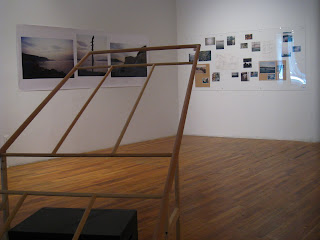
Monday, 24 August 2009

Collection Dubai


Hüseyin Bahri Alptekin | Lamya Gargash | Ivan Moudov | Fahrettin Örenli | Mamali Shafahi | Sophia Tabatadze | Nasan Tur | Tarek Zaki


The exhibition Collection Dubai brings together works by artists that involve practices of collecting, or of accumulating material that is then presented in a gathered format. This ranges from artists who consistently photograph the same type of environment to create a very tight series of images, to others who have collected found material that clearly works together in a collection of like messages or references and finally to those who follow one idea so succinctly within their practice that their ongoing output in itself clearly forms a collection. The other half of the title: Dubai; is intentionally ambiguous and is included in order to question the titling of something as broad and diverse as a collection of art; in this case with regard to a specific collection* that the exhibition's participating artists have been invited to include their work in, even if they have no contact with the city or its newly formed art initiatives. The title therefore questions what it means to use a regional tagging device, in this collection's case as a verifier and a commercially understood entity. The inclusion of the name Dubai also in part refers to the current trend of copying and accumulation that is taking place in the UAE, which, by extension, the work of Lamya Gargash references. In her series of photographs Familial Gargash obsessively brings together a collection of lesser-known imagery from the Emirate's, the bedrooms and lobbies of its local 'one star' hotels, offsetting the Dubai tag's usual analogies of style and glamour.

Amsterdam based artist Fahrettin Örenli has been invited to present a new installation of his fanatically created drawings and photography that form part of his ongoing research into conspiracy theories that often stem from the EU's strategies of integration and the West-East oil pipeline. In contrast two works by Sophia Tabatadze are theoretically collections, but exist as the only element of a potential ongoing practice.

An installation of three videos from Hüseyin Bahri Alptekin's series Incidents present hundreds of images taken in three locations in which disparate tales are woven together to present the touching impression of how individuals can control and organise one moment in space and time, as the world continues its activities around them. Ivan Moudov's Fragments is an incredible assemblage of collected parts taken from different artworks that Moudov found in various museums, galleries and art centers in Europe. The suitcases that contain Moudov's collection act as a portable museum that traces a precisely selected artistic heritage.

In contrast Tarek Zaki's History of O gathers a group of mundane circular objects that are cast to look like rare and valuable archeological artefacts. As Mamali Shafahi works on 2500 collages that hint at the many truths, lies, tensions and ambiguities that exist in and surround Iran; Nasan Tur's installation Good News presents in a newspaper format a sample of infamous media images that at the time of going to print illustrated stories telling only good news, but which in retrospect have not always encountered such happy endings.


*The initial motivator for the framework of the exhibition was to consider the structure of the Artist Pension Trust (Dubai), an initiative that offers selected artists the opportunity to invest works into regional collections in a shared scenario of risk diversification and mutual participation. These collections are temporary and variable as works are committed and sold over a forty-year period and ultimately all the works are dispersed.


Opening reception Saturday 5 September 2009, 21.00 hrs


Exhibition until 25 October 2009

Location: SMART Project Space, Arie Biemondstraat 105-113, Amsterdam


Wednesday, 12 August 2009

Tape Republic


Istanbul is a patchwork of commodity zones, where specific types of products cluster together, classifying themselves and the neighbourhoods they inhabit. For example, leading down to the Galata Tower is the 'music hill', so nick-named for its series of shops that stock musical instruments and DJ hardware. Just around the corner is the 'lighting district', a glittering constellation of window displays, each one hosting an array of chandeliers, lampshades and behind the scenes switches and bulbs. Classic tourist hubs of similar same-zone products include the Egyptian spice market and the fish bazaar. Then there are the more locally frequented such as the sewing machine floor in IMC and the hardware street of Karaköy. The repetition of what is for sale in each of these areas is phenomenal. Shop after shop will seemingly sell almost identical produce, leaving unacquainted passers-by with concerns as to how anyone makes a living. Yet, despite occupying prime, central city territory, many of these shops are just the display floors for trade purchase, where bulk acquisitions of a particular light fitting, or reams of cloth are made.

Istanbul's most famous production-lines include those in textiles and finished garments, with 'made in Turkey' a common tag on multinational fashion brands such as H&M and M&S. There is one district in the city that caters for a precise genre of lower-level clothing 'brands'. Common name tags include Red Star, Romana Botta, Collins, Motor Jeans and Junker and these all generally migrate east rather than west. This district is Laleli, an area of around two square km that contains over 50,000 shops all selling ready made textile garments to ex-Soviet countries to the tune of $5 billion a year. This extensive business apparently all takes place off the record in what appears to be an inner-city, unregistered, tax-haven.

Every day hundreds of packages of clothes are dispatched by boats and trucks first to the Ukraine and Bulgaria before they are dispersed further afield. Until 2001 these parcels would accompany flying customers as luggage, but since 9/11 the airlines started to refuse such packages, not because of them being overweight or because of custom issues, but because of the way they were wrapped - with brown tape, lashings of it, sometimes covering every inch of the black sack or cardboard box containing the product within. It is this extreme use of brown tape that caught artist Osman Bozkurt's interest and not only its application on the parcels, but the fact that its popularity has become something of a local obsession, with its stickyness and usefulness meaning that it ends up everywhere in Laleli.

Bozkurt's work Tape Republic (2009), first shown as a large, multi-faceted installation in the exhibition Europe XXL at Lille 3000 (2009), is a homage to the district of Laleli and the unlikely product that has for him come to classify it more so than its textile trade. Bozkurt first began documenting the multiple uses of tape on the streets as a short-term solution to fixing broken handles and dummy limbs, marking territory, softening the edges of road bollards, to contain escaping electric wires within their lamp posts and even to replace - with thick stretches of back and forth action - the missing woven seating of chairs. These simple ways of 'getting by' and 'making do' are common sights in Istanbul, yet here the tape's prolificness forms a visual unity and classifies Laleli's preferred tactic of improvisation.

The street-found subsidiary and non-official uses of brown tape are the remnants of a more industrial approach to its application by the local cargo companies. One cargo company even requests that all packages it handles are completely covered by brown tape. The resulting indistinguishable brown, shiny lumps are then tagged by marker pen with the numbers or text that refer to their destination, although given their visual uniformity it is obvious that many must go missing in transit.

In the installation Tape Republic a selection of these packages take center stage. Without an assigned destination they sit in the gallery space as sculptural entities and as a sort of memorial to the final products of Laleli's activities, before they become untraceable, caught up in a system of diverse distribution. In the gallery space the packages emit recordings from small speakers hidden in their interiors that play out the sound of brown tape being drawn, sliced and applied, over and over again. This never-ending rhythm links to a film that captures the skill and speed of two cargo guys precisely wrapping their products. It takes about two rolls of tape to cover an entire sack or box and there is a clear pattern of application that has been mastered over the years. A special technique for breaking the tape involves rapidly creasing a section sticky side down and then speedily tugging at each side so that it splits at the fold. Then come the handles, which are spun and tweaked into shape. Like the lessons of the tape's potential usefulness seen in Bozkurt's photographs his film uncovers another unknown skill of convenience – the cutting of tape without a knife or scissors, a trick that every visitor to the exhibition will later try out at home.

Tape Republic collects all the little nuances of Laleli and its tape obsession in order to refer to much larger global circuits of production, consumerism and distribution. While Bozkurt puts on view a micro world that is unregistered and unregulated, it is a pool of activity that supports so many people and links into a regional network with historical and cultural precedents. The free use of tape in Laleli, is reflected in Bozkurt's works where he allows it to extend beyond the parameters ofTape Republic. The sticky substance with its pungent chemical smell, hangs uncut from the edges of the photographs it supports and unfinished rolls remain ready for future use on the floor. And so, like the unregulated world it contains in Laleli, the tape is in Bozkurt's work both specifically applied and at the same time left to its own devices, a metaphor for a community that binds itself together through a system of shared aspirations and the possibility to remain flexible.

Saturday, 1 August 2009

Thursday, 2 July 2009

Monday, 25 May 2009

Nedko Solakov


Encompassing three decades of his work, Nedko Solakov’s retrospective at the Sofia Art Gallery is his first large-scale exhibition in Bulgaria since 1988. Curated by Iara Boubnova and Maria Vassileva, the exhibition is arranged in chronological order, with each year of his production––from 1981 to present––noted on a board. The show begins with a selection of Solakov’s early oil paintings, which brought him acclaim in the 1980s. Some of these are gathered in groups, are displayed on the floor, lean against the gallery’s plinths, or are installed on the columns. This unconventional arrangement introduces a momentum to the spatial layout and allows the visitor to clearly understand the evolution from Solakov’s figurative paintings to his installations and videos, which underscore his deft ability to compose complex and extremely detailed stories.

The genius of this retrospective lies in the way it creates a narrative thread that journeys through the development of Solakov’s works, so that the exhibition appears as a new work itself. In the style of many of his hand-annotated works, such as his ongoing “Wallpapers” series––of which there are three in the exhibition, from 1993, 1995, and 2002––Solakov has added a written commentary of short penned texts on the plinths, on walls, on the floor, and next to works throughout the show. The viewer is in effect led through the exhibition by Solakov, but unlike didactic gallery labels, this commentary is not descriptive; instead, it appears as an element of the works on display and as an added layer that functions as the retrospective’s own narrative. Also framing the entire presentation is a rendition of Solakov’s 1998 work A Life (Black & White), wherein two painters––one making the walls black and the other following to return them to white––work for one month at opposite sides of the gallery. This perpetually changing yet rhythmically repeating backdrop animates the space and transforms the presentation of Solakov’s linear biography into a web of shifting narratives, which, in turn, like many of his works, propose a more complex and cyclic chronology.

Monday, 23 March 2009

A Play in a Panorama


The scenery is magnificent. The scale and drama that make up the vistas of crags, crevices and clouds, breathtaking. In the midst of this, while nature timelessly endures, Bashir Borlakov stages momentary acts, or as he describes them 'sentences' in history that are then forever locked into the memory of an otherwise perfect landscape.

In Panorama 7, seven men, mere dots in a vast mountainous range, pull determinedly on a rope. Whether they are rescuing someone, lowering one of their number, or pulling a hidden load is unclear. This could easily be a scene from a film, in which the result of the seven men's endeavours might appear in the next frame, but Borlakov captures them still in their act and so the sentence they begin to write remains open.

There are six other images in Borlakov's Panorama series. Although they are all shot in the Caucasus Mountain Range, in Russia close to the Georgian border, the composition of the land is strikingly different in each photograph, as are the human acts these backdrops both conceal and reveal. In the furthermost left corner of the first image is a scene so small that it can be easily overlooked, but when noticed, it evokes a pang of concern as two men are seen bending down in a meadow battering something with a heavy rock. In another, a body appears to have been taken from the trunk of a car and is being held in an odd position dangerously close to the edge of a rock face. In the following images there are four more unusual events - a man is elevated against a perfect blue sky hanging from the legs of two flying white geese; eight women in traditional dress walk in line across a plateau; a uniformed man, assisted by another undresses, while behind him a third crouches naked in the grass; finally a group of boys stand tentatively looking over a cliff edge as if about to dive.

Photographed in a place of Greek legend - the mountains where Prometheus was chained to a rock with an eagle eating away at his liver as penance for giving man the gift of fire - myths are easily born and tales of the immortal, heroes and tortured soles infinitely cited. The term Panorama is taken from the Greek Pan horama, meaning the all-viewing, which is a perspective that it is already impossible for mere mortals to see fully unless via a constructed and often artistic creation. Adding to this lineage of spiritual observations Borlakov seems to include in his works clear references to Biblical imagery – the eight women form a line of pilgrimage, the man lifted by white birds hangs in the shape of a crucifixion and at the same time, along with the de-robing and hence metamorphosis of the uniformed guard, his freedom via flight refers to potential resurrection. The implication of these symbolic gestures can in our present day be taken to cite issues of political turmoil, corruption and racial hatred, but in the end, Borlakov's works pertain to all and none of these sources. Instead he does no more than imply at what these narratives might entail and by using the form of the panorama cleverly implicates the viewer within his composed environments. Humbled by the power of nature and unnerved by the impossibility to ascertain what is actually going on, or of what happened before and what will happen after these events, we are forced to acknowledge our suspicions and to battle with the natural urge to make judgements based on nothing more than a still image.

And so we ponder. Are these events connected? Is the body taken from the car-boot the same one that was being beaten by rocks and is later seen being pulled back from the valley by the seven boys and their rope? Should we imagine that these are horror stories of torture and murder, or are they harmless gestures that simply arouse suspicion? The tension within these images is further magnified by the Jurassic sense of time and scale that features on a grand-scale in contrast to the small interventions undertaken by mankind. And yet, even amidst these awesome sweeps of nature, the most microscopic human presence and action demands explanation. While the drama of the activities going on is somewhat belittled in the face of the much larger force of nature, the implied issue of morality in these acts is so controversial that man maintains his position as the other most dominant and erratic power to exist on earth.

Friday, 13 February 2009

Taipei 08


Sunday, 8 February 2009

Sothebys


Wednesday, 10 December 2008

Sunday, 2 November 2008


Sunday, November 2, 2008
Kunsthalle Basel presents:

Catching Breath - Film programme and artist talk
In addition to the solo show Mutual Issues, Inventive Acts by Ahmet Ögüt (APT Dubai) in April this year (20.04.-08.06.2008), Kunsthalle Basel presents an event in two parts:

11am-12.30pm Part 1:
Film programme with works from Ziad Antar, Lamia Joreige, Mounira Al Solh (APT Dubai), Ahmet Ögüt (APT Dubai) and Erkan Özgen.
With an introduction by the curator November Paynter.
Location: STADTKINO BASEL, Klostergasse 5

2pm-3pm Part 2:
Artist talk - Ahmet Ögüt and November Paynter (Director, APT Dubai) in conversation
Location: Kunsthalle BAR, Steinenberg 7

Picking up on the expression of hope often used by Ahmet Ögüt to describe a certain aspect of his practice, this video programme includes works by Ögüt as well as by other artists that appreciate and elaborate the many nuances of this feeling. The artists' references range from the inspiration created on encountering the unexpected, to the anticipation of certain forms of freedom imagined via acts of escape, to the lure of the other and personal moments alone, with each video individually involving its own perspective of hope that is experienced like a breath of fresh air.


Single admission: CHF 12.-/6.- for members of Basler Kunstverein
Combi-Ticket for films and talk: CHF 20.-/10.- for members of Basler Kunstverein
Reservation: 061 206 99 00/01

In cooperation with CULTURESCAPES - Türkiye.
Further information on the festival www.culturescapes.ch

Further information on the event
www.kunsthallebasel.ch/events/events/340

Monday, 27 October 2008


NADA VIDEO NIGHTS
Wednesday 10/29
6:30-8pm

at John Connelly Presents
625 W 27th Street (between 11th and 12th Avenues)
NEW YORK CITY

We now continue our series NADA VIDEO NIGHTS into October with a special feature program in collaboration with Artist Pension Trust (APT) that will be screened at John Connelly Presents. Popcorn and Grolsch beer will be served. You are encouraged to bring a lawn chair or a blanket. We'll have Astroturf on the floor to give a sense of that "out-of-doors" experience. We look forward to seeing you there!

Admission:
$5 suggested donation
NADA Members - Free

Wednesday 10/29, 6:30-8pm

Feature program: The State We're In- A selection of videos from the collection of the Artist Pension Trust (Dubai) that in different ways and via a wide variety of references seem to offer pertinent reflections on the accumulating states of global turbulence, and the resulting feelings of indecision and confusion. Curated by November Paynter, Director of APT Dubai, and independent curator, the program features work by Fahrettin Örenli, Ergin Cavusoglu, Ahmet Ögut, Vlatka Horvat, Basim Madgy, Loukia Alavanou, Wael Shawky, and Mario Rizzi (APT Dubai).

Short program: Favorite YouTube videos submitted by Miami friends: Nektar De Stagni, Thomas Hollingworth, Bhakti Baxter, Federico Nessi, Samantha Kruse, Nicolas Lobo, Victor Barrenechea, Martin Oppel, and Kevin Arrow. Curated by Ruba Katrib, Assistant Curator, MoCA North Miami.

For more information on NADA VIDEO NIGHTS or if you have any questions or concerns regarding other New Art Dealers Alliance (NAD) public programs please contact Frederick Janka at frederick@newartdealers.org or (212) 594-0883. Please visit our website for more information www.newartdealers.org

Saturday, 26 July 2008

Radikal

Tuesday, 8 July 2008

New Ends, Old Beginnings

July 11th - September 3rd, 2008
Bluecoat and Open Eye Gallery, Liverpool

Can Altay, Ziad Antar, Lara Baladi, Cevdet Erek, Tarek Al Ghoussein, Chourouk Hriech, Randa Mirza, Michael Rakowitz, Hrair Sarkissian, Sharif Waked and Tarek Zaki.
Curated by November Paynter 


>Can Altay, Mirrorworld, c-print, 2008


The cities of the Arab region are incredibly diverse in their form and character, including sites of ancient civilisation, as well as some of the most youthful urban establishments in the world. Similarly, their heritage and contemporary culture are varied and complex. While cities such as Baghdad struggle in the midst of war to protect their museums and architectural heritage, others like Cairo attempt to balance tensions between ancient history and 21st century culture. In some urban centres, including Damascus and Beirut, the structural skeletons of tomorrow’s heritage have been overtaken by rapid and incomplete development, or the devastation of war. Then there are cities such as Dubai and Abu Dhabi that are in the early stages of promoting a new urban cultural legacy by creating a space for the arts from scratch and housing selections of international art from collections such as the Guggenheim and the Louvre.

New Ends, Old Beginnings investigates a very particular geographical sphere through artists’ responses to the many layers of local and everyday culture, a perspective that the world’s media often overlooks or avoids making visible, preferring instead to present images that shock and manipulate. Questions the artists engage with include: what aspects of a city's culture can and should be saved and shared? How can hundreds of years of history co-exist with current and future cultural practices? Can a newly created cultural hub ever be considered as authentic? An examination of heritage in its many forms - as physical, symbolic and traditional elements of urban reality - also informs how these cities are perceived by those from outside. What does tourism mean for cities of the Arab region and how abstracted is the virtual tourism fed to us by the media?

Considering the questions above, the works included in New Ends, Old Beginnings reveal features of, and help describe current responses to, the situation of cultural heritage in the Arab region through a contemporary lens. Works included in the exhibition have been carefully selected and commissioned to reference the specific themes of heritage, cultural industry and tourism, and to take into consideration the practices involved in protecting, maintaining, re-evaluating and perceiving heritage via art.

This exhibition has been supported by The Henry Moore Foundation, Liverpool City Council, Zenith Foundation, Open Eye Gallery, Liverpool Culture Company, Esmee Fairbairn.

Galleries at the Bluecoat:
Open daily, 10.00am – 6.00pm
0151 702 5324
info@thebluecoat.org.uk
www.thebluecoat.org.uk
the Bluecoat, School Lane, Liverpool L1 3BX

Open Eye Gallery
Open Tue – Sat, 10.30am – 5.30pm
Closed Sun – Mon
0151 709 9460
info@openeye.org.uk
www.openeye.org.uk
Open Eye Gallery, 28 – 32 wood Street, Liverpool L1 4AQ


Saturday, 5 July 2008

Isabel Schmiga


Polis

Schmiga is fascinated by an object or idea’s potential to change state, whether literally or figuratively. In many of her works existing objects such as ties, leaves, marbles and forks, or printed images and diagrams are transformed into new, more conceptually complex versions of themselves. But in her work Polis, her starting point is an extremely specific emblem – it is the Turkish Police badge, a designed composition of imagery that is already a socially and politically charged effigy.
Schmiga's version of this badge in her work Polis presents an extremely uncanny proposal. Through a layering of a carved relief atop the original design, Schmiga draws attention to the badge’s eerie skull-like shape: the outline of the skull is already marked out by the symmetrical, aerial view of a police cap that creates the shape of the badge; the double eagle insignia forms a mouth; the crescent moon and star motif an ominous third eye. As in Hans Holbein's The Ambassadors, 1533, the layered representation is rendered as if in anamorphic perspective and only becomes clear when viewed from an angle. As the cut outs appear and their depth gives a slight shadow, a perfect skull exudes. In this camouflaged state, the badge, like the police it adorns, amalgamates an aura of protection with an implication of fear.
Schmiga became obsessed by this authoritarian ornament after spending several months living opposite a police guard in Istanbul, Turkey. For her, the feature of the skull was always present in the shape and detailing of the badge and her double-relief print was made as a response to the image she believed she was seeing all around her. This badge is omnipresent in Turkey, seen on the police uniform, as well as the forces' cars, buses and stations, so its appearance in Schmiga's work is in part due to its being an everyday encounter, just like any other repeated image she was currently experiencing for the first time in the context of this location. For her this badge, as with any other object, was available to be taken and morphed by her personal reflection. So while Schmiga's work Polis of course refers to a media acknowledged concern about Turkey's police presence, attitude and occasional use of disproportionate force, as well as to a general atmosphere of contradiction and awkwardness that is caused by tensions of group mentality and nationalism, it is also a simple response to a visual slippage created by the shape and design of the badge.
This slippage is then pushed by Schmiga, so that other signs and symbols become more obviously integrated into her interpretation of this emblem. By placing the mouth of the skull in line with the double-eagle motif, she visually replicates a different statement of nationalism, the preference for males to don a moustache. The third-eye is formed by Turkey's flag, suggesting the overriding presence of National authority, but at the same time it is a reference to Islam and the rule of the former Ottoman empire; a combination of associations that can be read as the eye of knowledge, a control of will, or a system of belief, all issues that are very pertinent to the political situation in Turkey today.
When exhibited Polis consists of a repetitive series of Schmiga's photographic reliefs snugly butted up against one another filling the length of an entire wall. There are never less than five of the framed images presented at one time, a reference to the group presence of the police in Istanbul especially in the central entertainment zone of Istiklal Caddesi. Here police are nearly always present in groups of at least three, and often usually five or more. During public demonstrations or pre-publicised events when the police anticipate their necessity, they often outnumber those they are supposedly protecting, but are in fact waiting to control. In Basel for Schmiga's exhibition in von Bartha Garage, 60 of the badges were positioned in a slightly uneven line hinting at the meagre allowance of individuality given to each member of the formation, as well as the tension felt in numbers and in the expectancy of friction. The skull seen in such prevalence and force also replicates the gas masks often worn prematurely by the police before the potential, or actual release of tear gas, a practice that is not uncommon in the current climate of the city.
Hence for a variety of reasons and on many levels Schmiga's work creates a sense of deja vu for those who live in the vicinity of this badge. As the skull was always there for Schmiga, it is now also always there for those who have experienced her work. Through a simple visual act she has marked a new relationship between the public and their encounter with this particular sign of the police. More importantly her work encourages a more general moment of reflection for us all on society's level of acceptance of forms of power and control in our every day environment.


Lamya Gargash


The found rooms of Presence, along with their furniture, ornaments and décor, project a sincere, vulnerably human dimension. Each space exudes a feeling of loneliness and sorrow at their owner's abandonment. It is sometimes the state of deterioration that marks their lack of occupation, but in others, which were vacated perhaps just a day or two earlier, Gargash's steady, concentrated perspective captures the heavy atmosphere of desolation. While it is normal for the inhabitants of a home to become affectionately attached to its material elements and to experience sentimental feelings toward bricks and mortar, Gargash's photographs suggest that here in Dubai this condition works in reverse and that it is the apartments and buildings that are left prematurely in distress, while the previous occupants are happy to move on and let them go.

Things become 'old' or at least 'outdated' extremely quickly in a city that lacks an identifiable history of more than 50 years. Alone in its old age the Fahidi Fort is believed to be the earliest standing construction in the city and dates back to around 1799. The courtyard houses of Bastakiya where Gargash ironically exhibited her work earlier this year were built in the 19th Century, but even these buildings have been renovated with a mask of perfectly smooth wall-cladding that confuses their authenticity and brings them in line with the rebounding, replicative tone of the city.

Dubai's sudden and continuing acceleration of development, where new hotels, malls and homes appear every day, has infected its population with the constant desire for renewal. Gargash can remember the first shopping mall opening when she was seven or eight years old. In its wake and that of many other malls to follow, a style of 'conformative consumerism' exploded in the city. Family's began to trade their suddenly unfashionable homes for new modern alternatives. They would not even bother to take many of the house fittings and their possessions with them to their new abode, because these too were also already out-of-date. With no clear sense of an aesthetic, historic lineage of culture and identity to adhere to, the city's inhabitants moved on to adopt an homogenous modernist style of interior décor. In this process, a cultural leap was made that all but deleted the potential design and fashion preferences of the 80s and early 90s. While this seems to go unrecognised, or is of no concern to much of the population of Dubai, there are some who like Gargash, reveal a sense of nostalgia for a lost moment in time that can now never be.

The resulting atmosphere of non-stop change and a lack of material attachment with the past is clearly conveyed in Gargash's photographs. Fairly recent tastes in interior decoration that were formed by the post-oil-culture generation – grandiose chandeliers, co-ordinated wallpaper and upholstery, decorative tiles and early-model air conditioning units - together chart the beginning and end of a very short period in local domestic history. It is these key stylistic themes that provide the composition of many of Gargash's photographs and where her use of natural light eerily taunts the interiors, dulling the soft furnishings and gently tracing the ornamental details, rather than instilling in them a breath of fresh air, or life.

A variety of rooms are included in the Presence series, all found by Gargash in homes abandoned or about to be vacated. Certain of these have already become generic spaces with few references to their former lives, while others cling on a while longer to a scattering, or occasionally all their furnishings. A perfectly symmetrical and very decadent Majili (an Arabic sitting room) prematurely takes on the mood of a constructed museum set as Gargash's photograph predicts its coming demise. A series of lounge rooms, all complete with matching curtains, cushions and carpets, are already a dying breed. In one of these rooms the television set is turned on, the still it hosts stamping the date and location on the photograph, in expectation of a future generation's curiosity.

These 'about to be left' interiors are juxtaposed by images of neighbouring sites that were perhaps photographed only weeks or months later into their abandonment, but are already empty and run down. These scenes seem to condense time, but in fact show how quickly a space can fall into decay. In an image that focuses on what would have been a grand spiralling stairwell and in others of the same apartment building this acceleration of physical change is strikingly clear. On several floors that were functioning as a lobby and living quarters only a month or so earlier, Gargash found stacks of old loaves of bread. In the short time between being abandoned and its inevitable annihilation and redevelopment, this inner-city apartment space was being temporarily used to dry a local baker's unsold and excess bread to later feed his farm animals. In another photograph a chair sits alone, sadly looking out to sea. Its back is torn of fabric and a broken down air conditioning unit shares the same room. The subject of the work is not the unkempt objects or the empty chair, but the broken spirit and soul of a space and most specifically the absence of a person who should still be enjoying this view of the sea, sand and palm trees.

Gargash's series of photographs both depict and are conditioned by the perpetual velocity of the surrounding built environment. While she struggles to shoot certain spaces before they become obsolete, in only a year or two there may well be none left for her to discover. In the meantime her photographs are already acting as an archive of this unprecedented speed of change and in time they will be one of the few existing traces of a style and period of living that for now many are more than happy to leave behind.