Saturday, 6 February 2010

Ciprian Muresan / Yama


For the first time Yama hosts a hand-drawn animation that appears like a sketch on the night sky. A commissioned work by Romanian artist Ciprian Murean Untitled (2010) stems from conversations about his earlier work Pioneers (2008), an installation comprising forty lithographs that depict different children holding bags to their mouths. Many have misread the simple act that appears in each frame and assume that the children are blowing the bags up in order to burst them. Despite their naive appearance, they are in fact shown sniffing glue, a heartbreaking and depressing sight that is all too common in certain inner city areas and one that is particularly familiar to the public of central Istanbul. At the foot of the Marmara Pera and around the zone of Istiklal Caddesi every night young boys can be seen holding a bag of glue to their faces in the same way.

Rather than directly reference this act Muresan instead plays on the misreadings of his previous work and has produced for Yama a more humourous, but still dark, take on the issue. This time, just one child is highlighted and he is seen blowing up a frog that despite its inevitable likelihood of bursting surprises the boy as it explodes into thousands of pieces. A fun gesture turns out to be a cruel or perhaps simply un-controllable act and at the same time the image of the fairytale frog that turns into a prince/princess is thwarted. As we look up at the dark sky Untitled lights up Yama for a few seconds to propose that anyone can make a wish, but in an instant this bubble bursts and the sad reality of disappointment and broken aspirations that afflicts these individuals takes over from the childhood innocence of the frames before.
Commissioned for Yama by November Paynter.


Ciprian Muresan (b. 1977) lives and works in Cluj, Romania. He is an artist and the co-editor of VERSION artist run magazine and from 2005 an editor of IDEA art + society magazine [www.ideamagazine.ro] In 2009 Muresan was one of the representing artists for Romania at the 53rd Venice Biennale; the same year he also participated in among other exhibitions The Generational:Younger Than Jesus at the New Museum, NYC; Communism Never Happened, FEINKOST, Berlin and Incorrigible Believers, David Nolan Gallery, NYC.


Sunday, 15 November 2009

Haris Epaminonda

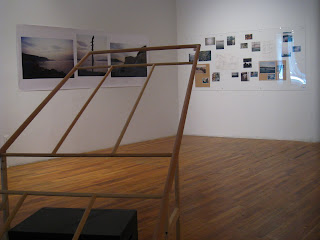
To the right of the entrance hangs a small, framed book page that depicts a man looking up at a towering termite mound. The unusual scale and perspective of this landscape with figure sets the tone for the formation and play of space experienced in Epaminonda’s “VOL. IV.” The exhibition follows Epaminonda’s solo presentation “VOL. I, II & III,” which took place at the Malmö Konsthall earlier this year, and here the mazelike reorganization of the space contains a series of three-dimensional collages that Epaminonda describes as “sentences. ” While the first is made up of just one found folio—the image of the man and termite mound—subsequent collages mix bought sculptures placed on pedestals with both black-and-white and colorful secondhand bookplates framed and hung or, in the densest composition, stacked against the wall. Her desire to play with traditional museum hierarchies and the usual formats of display is evident in each scene, but also in the way the presentation feels like an illustrated encyclopedia from which different images or shapes are allowed to haunt the memory, the relationships among them left open to interpretation.

What is striking is that the only objects made to measure by Epaminonda are the beautifully crafted pedestals, each one handpainted in a shade of white or eggshell gray, alongside carefully chosen palettes for the numerous frames. This attention to certain details shifts focus onto the pieces whose job it is to support the objects of display, pieces that in this exhibition also take on the more prominent role of masking and hiding selected iconography. A final statement locates the entire exhibition: A delicate wooden sculpture ensquares the gallery’s central column in a tense embrace, framing it as an implied image that ironically can never be captured in publication.

Monday, 2 November 2009

IDEA - Gulsun Karamustafa

Interview with Gulsun Karamustafa


Thursday, 15 October 2009

Thursday, 3 September 2009

Rehang


Rehang


Opening 5 - 7 pm, Friday 11th September


Rehang is a temporary intervention that will take place in the lobby of the Büyük Londra Oteli for the duration of the 2009 Istanbul Biennial.


In this infamous drinking haunt of Istanbul, paintings and objects by artists Anna Boghiguian, Farida El-Gazzar, Hala Elkoussy, Gülsün Karamustafa, Alisa Margolis and Shahzia Sikander will replace some of the existing framed works and paraphernalia that have for years decorated the lobby.


Hotel lobbies notoriously contain prints, paintings and ornaments and while these are often franchised selections, in the Londra's case they are personal acquisitions. The art works included in Rehang sit easily within this eclectic environment, yet at the same time the lobby creates a very different context for the works' appreciation compared to their usual viewing situation in a white cube gallery space. In this unique setting the included art works become first and foremost objects of decoration, but their references to notions of hybridity, layers of tradition and complex cultural concerns sets them apart from the myriad of found and collected items that surround them. It is this shared platform that creates new narratives and memories for the art works, as well as the Londra's surrounding possessions that may well share similar aspirations with regard to their selection, but are considered from a different perspective and usually do not involve a position of intent. At the Londra, Rehang raises questions of taste, value, commodity and how an art works' environment and location relate to its populist acceptance and its appreciation as an object of art.


Curated by Sylvia Kouvali and November Paynter


Grand Hotel de Londres / Büyük Londra Oteli

Mesrutiyet Caddesi. No: 117 80050 Beyoglu Istanbul

Monday, 24 August 2009

Collection Dubai


Hüseyin Bahri Alptekin | Lamya Gargash | Ivan Moudov | Fahrettin Örenli | Mamali Shafahi | Sophia Tabatadze | Nasan Tur | Tarek Zaki


The exhibition Collection Dubai brings together works by artists that involve practices of collecting, or of accumulating material that is then presented in a gathered format. This ranges from artists who consistently photograph the same type of environment to create a very tight series of images, to others who have collected found material that clearly works together in a collection of like messages or references and finally to those who follow one idea so succinctly within their practice that their ongoing output in itself clearly forms a collection. The other half of the title: Dubai; is intentionally ambiguous and is included in order to question the titling of something as broad and diverse as a collection of art; in this case with regard to a specific collection* that the exhibition's participating artists have been invited to include their work in, even if they have no contact with the city or its newly formed art initiatives. The title therefore questions what it means to use a regional tagging device, in this collection's case as a verifier and a commercially understood entity. The inclusion of the name Dubai also in part refers to the current trend of copying and accumulation that is taking place in the UAE, which, by extension, the work of Lamya Gargash references. In her series of photographs Familial Gargash obsessively brings together a collection of lesser-known imagery from the Emirate's, the bedrooms and lobbies of its local 'one star' hotels, offsetting the Dubai tag's usual analogies of style and glamour.

Amsterdam based artist Fahrettin Örenli has been invited to present a new installation of his fanatically created drawings and photography that form part of his ongoing research into conspiracy theories that often stem from the EU's strategies of integration and the West-East oil pipeline. In contrast two works by Sophia Tabatadze are theoretically collections, but exist as the only element of a potential ongoing practice.

An installation of three videos from Hüseyin Bahri Alptekin's series Incidents present hundreds of images taken in three locations in which disparate tales are woven together to present the touching impression of how individuals can control and organise one moment in space and time, as the world continues its activities around them. Ivan Moudov's Fragments is an incredible assemblage of collected parts taken from different artworks that Moudov found in various museums, galleries and art centers in Europe. The suitcases that contain Moudov's collection act as a portable museum that traces a precisely selected artistic heritage.

In contrast Tarek Zaki's History of O gathers a group of mundane circular objects that are cast to look like rare and valuable archeological artefacts. As Mamali Shafahi works on 2500 collages that hint at the many truths, lies, tensions and ambiguities that exist in and surround Iran; Nasan Tur's installation Good News presents in a newspaper format a sample of infamous media images that at the time of going to print illustrated stories telling only good news, but which in retrospect have not always encountered such happy endings.


*The initial motivator for the framework of the exhibition was to consider the structure of the Artist Pension Trust (Dubai), an initiative that offers selected artists the opportunity to invest works into regional collections in a shared scenario of risk diversification and mutual participation. These collections are temporary and variable as works are committed and sold over a forty-year period and ultimately all the works are dispersed.


Opening reception Saturday 5 September 2009, 21.00 hrs


Exhibition until 25 October 2009

Location: SMART Project Space, Arie Biemondstraat 105-113, Amsterdam


Wednesday, 12 August 2009

Tape Republic


Istanbul is a patchwork of commodity zones, where specific types of products cluster together, classifying themselves and the neighbourhoods they inhabit. For example, leading down to the Galata Tower is the 'music hill', so nick-named for its series of shops that stock musical instruments and DJ hardware. Just around the corner is the 'lighting district', a glittering constellation of window displays, each one hosting an array of chandeliers, lampshades and behind the scenes switches and bulbs. Classic tourist hubs of similar same-zone products include the Egyptian spice market and the fish bazaar. Then there are the more locally frequented such as the sewing machine floor in IMC and the hardware street of Karaköy. The repetition of what is for sale in each of these areas is phenomenal. Shop after shop will seemingly sell almost identical produce, leaving unacquainted passers-by with concerns as to how anyone makes a living. Yet, despite occupying prime, central city territory, many of these shops are just the display floors for trade purchase, where bulk acquisitions of a particular light fitting, or reams of cloth are made.

Istanbul's most famous production-lines include those in textiles and finished garments, with 'made in Turkey' a common tag on multinational fashion brands such as H&M and M&S. There is one district in the city that caters for a precise genre of lower-level clothing 'brands'. Common name tags include Red Star, Romana Botta, Collins, Motor Jeans and Junker and these all generally migrate east rather than west. This district is Laleli, an area of around two square km that contains over 50,000 shops all selling ready made textile garments to ex-Soviet countries to the tune of $5 billion a year. This extensive business apparently all takes place off the record in what appears to be an inner-city, unregistered, tax-haven.

Every day hundreds of packages of clothes are dispatched by boats and trucks first to the Ukraine and Bulgaria before they are dispersed further afield. Until 2001 these parcels would accompany flying customers as luggage, but since 9/11 the airlines started to refuse such packages, not because of them being overweight or because of custom issues, but because of the way they were wrapped - with brown tape, lashings of it, sometimes covering every inch of the black sack or cardboard box containing the product within. It is this extreme use of brown tape that caught artist Osman Bozkurt's interest and not only its application on the parcels, but the fact that its popularity has become something of a local obsession, with its stickyness and usefulness meaning that it ends up everywhere in Laleli.

Bozkurt's work Tape Republic (2009), first shown as a large, multi-faceted installation in the exhibition Europe XXL at Lille 3000 (2009), is a homage to the district of Laleli and the unlikely product that has for him come to classify it more so than its textile trade. Bozkurt first began documenting the multiple uses of tape on the streets as a short-term solution to fixing broken handles and dummy limbs, marking territory, softening the edges of road bollards, to contain escaping electric wires within their lamp posts and even to replace - with thick stretches of back and forth action - the missing woven seating of chairs. These simple ways of 'getting by' and 'making do' are common sights in Istanbul, yet here the tape's prolificness forms a visual unity and classifies Laleli's preferred tactic of improvisation.

The street-found subsidiary and non-official uses of brown tape are the remnants of a more industrial approach to its application by the local cargo companies. One cargo company even requests that all packages it handles are completely covered by brown tape. The resulting indistinguishable brown, shiny lumps are then tagged by marker pen with the numbers or text that refer to their destination, although given their visual uniformity it is obvious that many must go missing in transit.

In the installation Tape Republic a selection of these packages take center stage. Without an assigned destination they sit in the gallery space as sculptural entities and as a sort of memorial to the final products of Laleli's activities, before they become untraceable, caught up in a system of diverse distribution. In the gallery space the packages emit recordings from small speakers hidden in their interiors that play out the sound of brown tape being drawn, sliced and applied, over and over again. This never-ending rhythm links to a film that captures the skill and speed of two cargo guys precisely wrapping their products. It takes about two rolls of tape to cover an entire sack or box and there is a clear pattern of application that has been mastered over the years. A special technique for breaking the tape involves rapidly creasing a section sticky side down and then speedily tugging at each side so that it splits at the fold. Then come the handles, which are spun and tweaked into shape. Like the lessons of the tape's potential usefulness seen in Bozkurt's photographs his film uncovers another unknown skill of convenience – the cutting of tape without a knife or scissors, a trick that every visitor to the exhibition will later try out at home.

Tape Republic collects all the little nuances of Laleli and its tape obsession in order to refer to much larger global circuits of production, consumerism and distribution. While Bozkurt puts on view a micro world that is unregistered and unregulated, it is a pool of activity that supports so many people and links into a regional network with historical and cultural precedents. The free use of tape in Laleli, is reflected in Bozkurt's works where he allows it to extend beyond the parameters ofTape Republic. The sticky substance with its pungent chemical smell, hangs uncut from the edges of the photographs it supports and unfinished rolls remain ready for future use on the floor. And so, like the unregulated world it contains in Laleli, the tape is in Bozkurt's work both specifically applied and at the same time left to its own devices, a metaphor for a community that binds itself together through a system of shared aspirations and the possibility to remain flexible.

Saturday, 1 August 2009

Thursday, 2 July 2009

Monday, 25 May 2009

Nedko Solakov


Encompassing three decades of his work, Nedko Solakov’s retrospective at the Sofia Art Gallery is his first large-scale exhibition in Bulgaria since 1988. Curated by Iara Boubnova and Maria Vassileva, the exhibition is arranged in chronological order, with each year of his production––from 1981 to present––noted on a board. The show begins with a selection of Solakov’s early oil paintings, which brought him acclaim in the 1980s. Some of these are gathered in groups, are displayed on the floor, lean against the gallery’s plinths, or are installed on the columns. This unconventional arrangement introduces a momentum to the spatial layout and allows the visitor to clearly understand the evolution from Solakov’s figurative paintings to his installations and videos, which underscore his deft ability to compose complex and extremely detailed stories.

The genius of this retrospective lies in the way it creates a narrative thread that journeys through the development of Solakov’s works, so that the exhibition appears as a new work itself. In the style of many of his hand-annotated works, such as his ongoing “Wallpapers” series––of which there are three in the exhibition, from 1993, 1995, and 2002––Solakov has added a written commentary of short penned texts on the plinths, on walls, on the floor, and next to works throughout the show. The viewer is in effect led through the exhibition by Solakov, but unlike didactic gallery labels, this commentary is not descriptive; instead, it appears as an element of the works on display and as an added layer that functions as the retrospective’s own narrative. Also framing the entire presentation is a rendition of Solakov’s 1998 work A Life (Black & White), wherein two painters––one making the walls black and the other following to return them to white––work for one month at opposite sides of the gallery. This perpetually changing yet rhythmically repeating backdrop animates the space and transforms the presentation of Solakov’s linear biography into a web of shifting narratives, which, in turn, like many of his works, propose a more complex and cyclic chronology.

Monday, 23 March 2009

A Play in a Panorama


The scenery is magnificent. The scale and drama that make up the vistas of crags, crevices and clouds, breathtaking. In the midst of this, while nature timelessly endures, Bashir Borlakov stages momentary acts, or as he describes them 'sentences' in history that are then forever locked into the memory of an otherwise perfect landscape.

In Panorama 7, seven men, mere dots in a vast mountainous range, pull determinedly on a rope. Whether they are rescuing someone, lowering one of their number, or pulling a hidden load is unclear. This could easily be a scene from a film, in which the result of the seven men's endeavours might appear in the next frame, but Borlakov captures them still in their act and so the sentence they begin to write remains open.

There are six other images in Borlakov's Panorama series. Although they are all shot in the Caucasus Mountain Range, in Russia close to the Georgian border, the composition of the land is strikingly different in each photograph, as are the human acts these backdrops both conceal and reveal. In the furthermost left corner of the first image is a scene so small that it can be easily overlooked, but when noticed, it evokes a pang of concern as two men are seen bending down in a meadow battering something with a heavy rock. In another, a body appears to have been taken from the trunk of a car and is being held in an odd position dangerously close to the edge of a rock face. In the following images there are four more unusual events - a man is elevated against a perfect blue sky hanging from the legs of two flying white geese; eight women in traditional dress walk in line across a plateau; a uniformed man, assisted by another undresses, while behind him a third crouches naked in the grass; finally a group of boys stand tentatively looking over a cliff edge as if about to dive.

Photographed in a place of Greek legend - the mountains where Prometheus was chained to a rock with an eagle eating away at his liver as penance for giving man the gift of fire - myths are easily born and tales of the immortal, heroes and tortured soles infinitely cited. The term Panorama is taken from the Greek Pan horama, meaning the all-viewing, which is a perspective that it is already impossible for mere mortals to see fully unless via a constructed and often artistic creation. Adding to this lineage of spiritual observations Borlakov seems to include in his works clear references to Biblical imagery – the eight women form a line of pilgrimage, the man lifted by white birds hangs in the shape of a crucifixion and at the same time, along with the de-robing and hence metamorphosis of the uniformed guard, his freedom via flight refers to potential resurrection. The implication of these symbolic gestures can in our present day be taken to cite issues of political turmoil, corruption and racial hatred, but in the end, Borlakov's works pertain to all and none of these sources. Instead he does no more than imply at what these narratives might entail and by using the form of the panorama cleverly implicates the viewer within his composed environments. Humbled by the power of nature and unnerved by the impossibility to ascertain what is actually going on, or of what happened before and what will happen after these events, we are forced to acknowledge our suspicions and to battle with the natural urge to make judgements based on nothing more than a still image.

And so we ponder. Are these events connected? Is the body taken from the car-boot the same one that was being beaten by rocks and is later seen being pulled back from the valley by the seven boys and their rope? Should we imagine that these are horror stories of torture and murder, or are they harmless gestures that simply arouse suspicion? The tension within these images is further magnified by the Jurassic sense of time and scale that features on a grand-scale in contrast to the small interventions undertaken by mankind. And yet, even amidst these awesome sweeps of nature, the most microscopic human presence and action demands explanation. While the drama of the activities going on is somewhat belittled in the face of the much larger force of nature, the implied issue of morality in these acts is so controversial that man maintains his position as the other most dominant and erratic power to exist on earth.

Friday, 13 February 2009

Taipei 08


Sunday, 8 February 2009

Sothebys