




 |
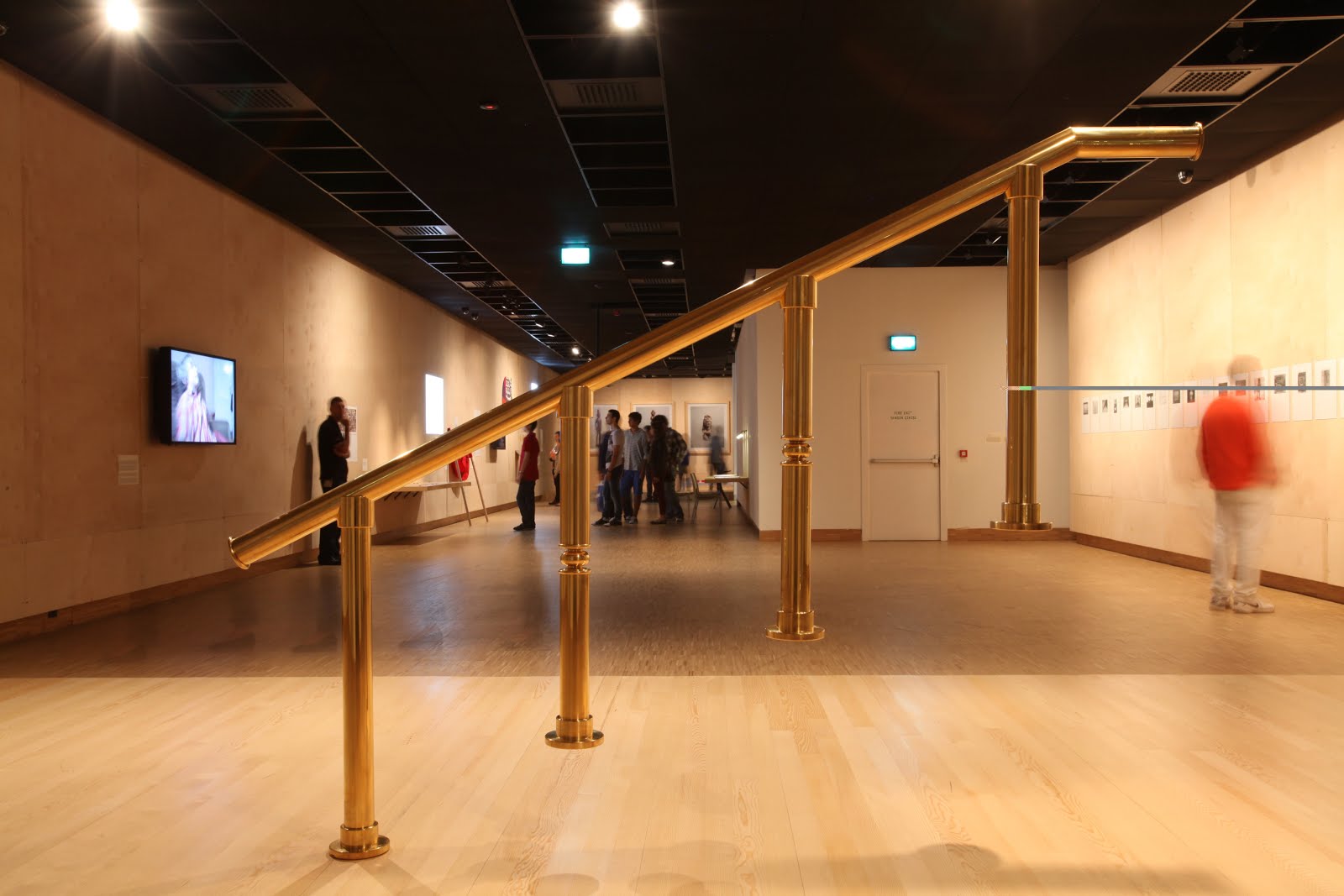
| Banque Bannister (2010), Hassan Khan, SALT Beyoğlu 2012
Hassan Khan draws out the subliminal in objects and circumstances that exist in social and historical environments. His works produce a tension between the nature of these objects and their changing contexts. Some of these objects stem from Khan’s personal biography, while others derive from figures and images of lingering artifacts that allude to specific civilizations and subcultures. This results in an artistic practice that is responsive to the monumental products of human development, collective moments and the immaterial charge of the objects and gestures that lie between.
 The Hidden Location (2004), Hassan Khan, SALT Beyoğlu 2012
A work such as Banque Bannister (2010) is composed from focusing in on one of these details taken from daily life. In this instance it is an exact copy of the bannister erected at the entrance of Banque Misr in Cairo. Yet Khan’s version is unrestrained by the original’s context and becomes its irrational replica. Once a gleaming introduction to the bank’s wealth and power that has slowly become weathered by the influence of the elements, Banque Bannister exists perpetually in this perfected form. It also defies structural logic, floating independently, refusing to acknowledge the laws of gravity. Khan further explores these ideas in The Twist (2012), where the precise and discrete beginning and end of a twist he had noticed in a railing is produced as a sculpture. For Khan, the nonfunctional twist in the railing, an ornamentation for its own sake that can be read as a symbol of property, wealth, knowledge and aesthetic judgment, in essence stands for the refinement of societies and cultures. These ideas were first considered in Khan’s and Amr Hosny’s work Lungfan (1995). Both artists worked together under the influence of an “almost telepathic” friendship and engagement with the world around them in the mid-1990s and with a keen understanding of contemporary society’s origins in ancient power structures. In the video aspects of civilization are documented in a spontaneous yet intuitive manner through still images and sound. Although produced seventeen years ago, Lungfan encapsulates many recurring interests for Khan, including the attempt to condense personas, objects and actions into a basic highly charged condition.

The Twist (2012), Hassan Khan, SALT Beyoğlu 2012
Jewel (2010) opens with an evolutionary throwback to a monstrous deep-sea fish that inhabits a dark world until it suddenly fossilizes into a contemporary object. The video references a culture and its music that can be imagined as exotic, but the two men who dance in casual clothing and without apprehension, alter this response. Their activity appears at first distant and absurd, but as we bear witness to their suspended moment in time, we are also gradually embraced by the dance-inducing rhythm. Another rhythmic work, DOM-TAK-TAK-DOM-TAK (2005) is the transformation and extension of one audio detail into a large musical production, resulting in a new form of this popular music genre. Khan first restructured and recorded with percussionists a series of generic Shaabi rhythms, he then hired session musicians to improvise over the beats without listening to one another. Finally he mixed these separate interpretations to produce six hybrid musical scores. On entering the installation the visitor encounters an emotionally complex unraveling of musical styles in tension with the automated structure of the composition process and its transmission via a mechanical and cold assemblage of equipment.

DOM-TAK-TAK-DOM-TAK (2005), Hassan Khan, SALT Beyoğlu 2012
DOM-TAK-TAK-DOM-TAK transforms human creativity and communication into a technical rather than personalized process. A similar approach was utilized in 17 and in AUC (2003), in which a constrained environment was created so that Khan could focus on and remember details of his undergraduate years spent at the American University in Cairo. Throughout this process, Khan sat in a sound-proofed one way mirrored room, whereby the external viewers could look straight into his eyes, yet he could not look back or even be sure that he was the subject of anyone’s gaze. the dead dog speaks (2010) functions in much the same way, but takes language as its basis. Distinct voices constitute the work and make visible the preliminary moment where the voice animates the character. From there, the work attempts to strip down the dynamics of language into basic relationships between the personas, which in this case revolve around a computer generated Egyptian film icon, woman and dog. Different voices speak through each persona and bring them to life. Likewise in stuffedpigfollies (2007), six inkjet prints present illustrated pigs, yet human characteristics are imitated via their gestures and expressions. The pigs are used as a trope for Khan’s consciousness and aim to portray some of the logic of his dreams. Merging the living with the nonliving and presenting the space of imagination and dreams, Khan uses these illustrated pigs as a reflection of different roles and inner mental awareness.

Installation view (that includes stuffedpigfollies), Hassan Khan, SALT Beyoğlu 2012
The logic of dreams also inspires diagrams no 1-6 (2007) and The Alphabet Book (2006). In diagrams no 1-6 Khan turns every dream into a formula that is used to produce a structured diagram. While in The Alphabet Book, images are mined from his periods of sleep to create a narrative connected to the letters of the alphabet. This process of drawing on imagery from a subconscious experience of the world is comparable to the way the objects in The Agreement (2011) have been sourced from fictional narratives based in the social context of contemporary Cairo, while Photographs of statues owned by the

The Alphabet Book (2006), Hassan Khan, SALT Beyoğlu 2012
Khan’s works function as individual projects; yet, they connect to one another, building a network of relationships and cross-references that unravel during the course of experiencing the exhibition. While engaging with objects and subjects that appear familiar, Khan sets them in dialogue with references to very personal and intimate sources that he often chooses not to disclose. He relies on detailed observations of humanity and interactions with the highly enigmatic gestures of individual consciousness, and the works he produces are very formally articulated –an investment in a language that he sees as essential to the very understanding of art practice. These alternating proximities, to the personal and the formal, shift and reformulate, often causing moments of tension when attempting to grasp Khan’s meaning, yet an open encounter is always available for the viewer. The selected works in this exhibition exemplify Khan’s methods of presenting such paradoxes, which lie within societies and the cultures they produce, implicating himself, and us, within a multitude of scenarios and historical remnants.
Written with Fawz Kabra and Hassan Khan for the exhibition Hassan Khan at SALT Beyoğlu; September 21, 2011 - January 6, 2013.
All photographs by Serkan Taycan. |


The street is lit up by a warm red glow: 'La vie est à nous' reads a neon light framed by the window of Analix Forever. A positive phrase, so emotive and inspiring. A quote that seems to offer endless potential. It is all these things, especially when glanced upon hanging there alone, and for the passerby it burns on the retina and inspires the memory. Foremost a sign and title, the neon also takes on another role as it shrouds the space of Mario Rizzi's one-person exhibition at Analix Forever in colour. It is a sentence appropriated from two major sources by Rizzi to act as a canopy for a range of people's untold or more often unheard stories. While the reference to the 1936 film of the same name is not specific for Rizzi, he clearly carries a similar conscience to share with as many as possible the voices of the marginalised. Rizzi's use of the neon can also be imagined as a sequel to the vertical light installation of the same sentence and colour that opened Bertolucci's “Il Conformista” (1970) –but again this is ultimately not so important for Rizzi and hence the question introduced to the audience is whether this neon gesture, which hangs so bold and proud, can be read as a visual statement that plays with a saying for its own means.
Huddled under this malleable headline are three of Rizzi's video works and a selection of his photographs. “The Chicken Soup” (2008) and “impermanent” (2007) are substantial video pieces, to be viewed and reflected upon with dedication and compassion. Each film enters into the densely complex lives of Rizzi's chosen subjects and by way of the artist's embedded experience (Rizzi usually lives for months on location with the people he involves in his work) and precise editing, the protagonists' stories are elevated within a frame that feels very much inspired by their own personal feelings, and the spirit and nature of their situation. A cinema setting hosts “The Chicken Soup” and we are invited to enter for a while the lives of two women who were taken to Taiwan as migrant, virgin brides. While their stories are full of trauma, as they are first controlled by their broker and later their husband, mother-in-law or others, Rizzi also draws out each woman's beauty and hints at moments of hope despite their vulnerability, particularly in a scene where one woman dances for his camera. In the main space of the gallery the neon is balanced by the strong statement of ”impermanent”, a portrait of a 96 year-old man who dreams of and for Jerusalem, who talks of war and peace, responsibility and desire. Filmed in Amman, the film manages to merge one moment together with a lifetime and a whole century of shifting history and geography. As if he knows the title of the exhibition the protagonist of “impermanent” describes in his monologue that 'life is ours' to learn from, to shape and to share.
The photographs included in the exhibition individually embody a separate time, location and experience for Rizzi. Despite all the footage he has taken while working on videos, as well as the many photographic stills he has made or invited of others for books and research, it is extremely intriguing that each time-period in his practice is now marked by just one enduring image. There is a tenderness to this sparse, unembellished approach to imagery and it mimics the care that Rizzi takes when he works with others in his films. The fact that the photographs included in “La vie est à nous” are not shown alongside their accompanying film, video or book frees them from the danger of becoming the title image or poster pin up, and this is a concern that Rizzi challenges in a different way by means of his fabricated cinema poster for his video work “Murat and Ismail”.
“Den Dolder” (1999), a photograph taken by someone else, shows a woman lying face down in the snow. Initially taken as part of a project in which Rizzi gave throw-away cameras to the patients of a psychiatric hospital (to use, throw or sell as they chose) he was only intrigued by the images that did not include a face. A book of these photographs was produced and yet the only human, albeit without a face, was this girl freezing herself as if life had stopped and she knew nothing else than to share her despair with nature by numbing her pain with its cold. “Paris” (2002) is also faceless, but the movement of the girl's hair shows she is very much alive and could spin around to face the camera at any second. She is a friend of Rizzi's captured crossing the street, her vivacity making it into this hand-picked pile of images maybe because she acts as a counterbalance to “Den Dolder”. Rizzi again inserts a moment of hope that within the frame of the gallery traverses time and space. “Drafting Moods” (2002) is also a lucky shot, taken backstage one evening after a theatrical performance. It is the only photo taken by Rizzi during this 2002 project where he again asked others to take images on his behalf. “New Orleans” (2008) is the interior of a temporary living situation inhabited by an illegal immigrant rebuilding a home in New Orleans. “Tarantella” (2003) a couple dancing as part of a project in Berlin where Rizzi created a space on the S-Bahn route for classes in life-painting, photography and dance. Finally “PINK!” (2005) is a portrait of a transvestite taken for a publication that included documents detailing acts of discrimination, police reports and immigration issues. “PINK!” again, is the one image that endures in this series, another photograph that needs no explanation as it humbly speaks a thousand words.
Perhaps this other side of Rizzi's very precisely tuned practice began with “gling-gló memo” (2001), a film edited mainly from found footage of which some sections include the artist as a child. There is no dialogue and the editing contains repeats and turns around in and about itself as if Rizzi himself has entered a conundrum and a maze of his own past that he is trying to solve. The work closes on an image of Rizzi and two of his cousins. The women wear very similar dresses and this repetition naturally exaggerates the effects of Rizzi's labyrinthine editing. But at the same time he holds this frame, he pauses the work right here, as if the tangle has become too much and by extending this one moment in time something more, something clearer, an answer may emerge. This one image, the final still, is then lifted from its impossible condition within the film - where it exists as both past, present and memory - to join the other markers of Rizzi's practice on the walls of the gallery. Here it takes a special place as the only filmic still that is liberated from the cycle of moving-image, and again very tenderly Mario gives it the opportunity to exist outside of its journey and in this precise and only case, his own personal story.
 | | ||
Philadelphia Museum of Art | |||
 Christodoulos Panayiotou, detail of "(Untitled) ACT I: The Departure," 2007. Courtesy of the Collection of Nicos Pattichis. | | Live Cinema/In the Round: Contemporary Art from the East Mediterranean September 17, 2010 – February 6, 2011 Philadelphia Museum of Art 26th Street and the Benjamin Franklin Parkway Philadelphia, PA 19130 (215) 763-8100 philamuseum.org | |
| Share this announcement on: Facebook | Delicious | Twitter | |||
SIX ARTISTS FROM THE EAST MEDITERRANEAN EXPLORE THE INTERACTION BETWEEN CINEMA AND REALITY Live Cinema/In the Round (September 17, 2010 – February 6, 2011) features the works of Ziad Antar, Inci Eviner, Hassan Khan, Gülsün Karamustafa, Maha Maamoun, and Christodoulos Panayiotou, artists from the East Mediterranean region who explore how cinema informs representations of reality through videos, installation and performance works. The title, In the Round takes its cue from theater-in-the-round, in which the audience surrounds the stage, allowing a more intimate experience for the viewer and a more realistic performance from the actors. Inspired by this theatrical technique, the works on view are not simply projected on a two-dimensional plane; they surround the audience and also migrate to other galleries within the museum. In each work, the actors (or sometimes the blatant absence of an actor) play out a specific role that invites the audience to imagine other possible narratives for the backdrops that host them. Live Cinema/In the Round is organized by Istanbul-based guest curator November Paynter. The artists participating in this exhibition live in or are from countries located in the East Mediterranean, a region denoting the countries that are geographically located to the east of the Mediterranean Sea and happen to be linked by a continuous land mass. Over the course of the last decade the contemporary art institutions and initiatives in the countries of the East Mediterranean have created more opportunities for mutual cultural exchange and dialogue. A number of artistic residencies and funds now exist that encourage artists to travel between cities such as Cairo, Istanbul, Beirut and Nicosia. The artists selected for this exhibition often present their work in this region of the world and their inclusion in this exhibition was motivated primarily by their interest in performance-based practices and in particular the cinematic references found within their work. Some of the works in the exhibition make use of found film footage or reconstruct known film scenes, whereas others create a dialogue with artefacts in the Museum's collection. Hassan Khan' s work G.R.A.H.A.M. presents a portrait as both subject and audience in a continuously-shot real-time video of an individual asked to remain completely silent even while being interrogated off-camera by the artist. Gülsün Karamustafa's Bekledigimiz Günler (The Days We Have Waited for) (2007), is the portrait of Istanbul at a specific moment in time. The work is comprised of footage taken from 1960s and 1970s newsreels that viewed now appears self-promotional and as such emphasizes the power of cinema as a social tool of communication. Building upon an earlier theme exploring the relationship between Egypt's pyramids and its cinematic traditions, Maha Maamoun's 9-minute film2026 (2010) steps into the future to consider the pyramids and their relationship to Cairo's city structure 16 years from now. (Untitled) Act I: The Departure (2007) and (Untitled) Act III: The Glorious Return(2008) by Christodoulos Panayiotou suggest scenes of introduction and finale for the exhibition. Panayiotou's backdrop works present rolled theatre backdrops with a small reference photograph of their unfurled images as they would look when hung on stage. Infiltrating the historical galleries of the museum are three video works by Inci Eviner titled New Citizen (2009). Here, traditional decorative patterns are animated by moving female protagonists and their disconnected body parts in choreographies that deconstruct the surrounding motifs. In Ziad Antar's La Souris (2009) a toy mouse is wound up by the artist and directed at a real mouse trap over and over again. The scene is a simple empty stage where the mouse is the only performer. While Hassan Khan's video G.R.A.H.A.M. acts as a steady, contemplative platform for the exhibition that harks back to the genre of portraiture, it is offset by the dense content and clear film references of Gülsün Karamustafa's and Maha Maamoun's works. Christodoulos Panayiotou's backdrops appear to open and close a conversation between all the works in the exhibition while reminding the viewer of the defining role of the actor or narrator in a film, or the lack thereof. Inci Eviner's videos seem to have escaped the borders of the official video gallery to virally spread throughout the Museum, while finally, Ziad Antar's video La Souris is included as a hint for the audience to question what it is they respond to and then choose to see within an artwork. Related Programs: INCIDENCE September 17, 2010 at 7 p.m. Slought Foundation, 4017 Walnut Street, Philadelphia. Free to the general public. INCIDENCE, a live concert with Hassan Khan, will be presented in collaboration with Slought Foundation. INCIDENCE is a seamless, continuous stream of improvisational pieces and music compositions by Khan accompanied by video sequences specially shot by the artist. Live Cinema Live: An Afternoon of Conversations. September 18, 2010, starting at 1 p.m. Trabant University Center Theater, University of Delaware, 17 West Main Street, Newark, Delaware November Paynter and Adelina Vlas, 1:00 p.m. Nora Alter and René J. Marquez, 2:30 p.m. Hassan Khan and Brian Kuan Wood, 4:00 p.m. About the curator: November Paynter has been based in Istanbul since 2002 where she worked as a Curator at Platform Garanti Contemporary Art Center until the end of 2006. She was one of two Assistant Curators of the 9th International Istanbul Biennial in 2005. In 2003 she was the recipient of the Premio Lorenza Bonaldi per L'arte – EnterPrize and the first curator under the age of 30 to be recognized with this award. In 2007, Paynter took the temporary position of Consultant Curator at Tate Modern for the exhibitionGlobal Cities, before moving back to Istanbul the same year to work as Director of the Dubai Artist Pension Trust and as a freelance curator. In addition to writing texts for exhibition publications and artist monographies, she has written for art periodicals including Artreview, ArtAsiaPasific, Bidoun, andArtforum. About Live Cinema: Live Cinema is a series of programs in the Video Gallery of the Museum that explore the vast production of single-channel video and filmwork by a diverse group of local, national, and international artists. In the last decades an ever-increasing number of contemporary artists have appropriated these mediums as an artistic outlet, in a dialogue with the early video and Super 8 practices of the 60s and the tradition of experimental filmmaking. Each program of the Live Cinema series focuses on a specific aspect of this work, in order to both map and analyze this important facet of contemporary art production. This exhibition is made possible by The Women's Committee of the Philadelphia Museum of Art and The Turkish Cultural Foundation. Public events are supported in part by the University of Delaware Interdisciplinary Humanities Research Center and by the Slought Foundation. | |||
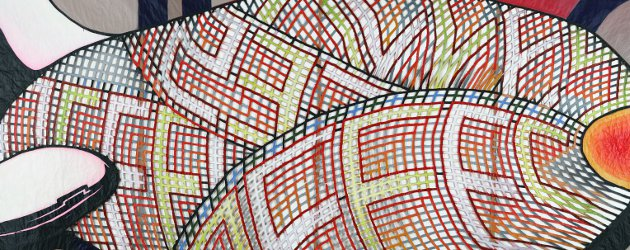
It is impossible to predict what effect an exhibition space and time will have on Guclu Öztekin's works. Three weeks ago the floor of Rampa was almost obscured by a scattered carpet of his paintings and sketches. Yet up until the moment that installation began this paper-based portfolio had only experienced its first period of production. Once in the exhibition space, a secondary process, which saw the paintings morph into and with the gallery's walls and floor, began. This undulating, cognitive involvement Öztekin assumes with his works and the new forms and techniques he applies to them as time progresses, forms the essential substance of his practice. While each painting was previously autonomous in its own frame of paper, when re-positioned in a three-dimensional exhibition context Öztekin sets to work once again to assert a new layer of language to unify threads of cross-reference throughout the space.
Öztekin explains his process of working as one of following a series of channels. These channels represent different focuses and applications of techniques, but they do not always follow one direct path and can branch off on another tributary as the context shifts. Several channels clearly prevail within Rampa: firstly and most true to the previous stage of production - there are the paintings that have simply been hung without any on-site alterations; then there are the site-specific wall paintings conceived during the installation period; another channel allows for the multi-layering of works, where either a number of works or techniques become one, or one work becomes many; a common channel is that of erasure; and lastly in contrast to the former, is a play on dimensions whereby what was previously a flat work on paper is now seen in Rampa as a sculpted three-dimensional form. These channels criss-cross the gallery and place the audience in the midst of a web of shapes, forms, techniques and repetitions that express the culminating channel: one of composition.
It is intriguing that most of Öztekin's works start their lives as rather traditionally rendered paintings. Often the canvas is a sheet of rectangular paper on which he paints images that can be read as understood forms – such as faces, characters, cartoon-like vehicles and text. Yet this is just the base for the more defining acts of his practice, within which he speculates on the limits of painting, and more literally on the limits of his own 'traditional' paintings, their surface and content. The act of erasing his own works, by inflicting them with punched out holes and scalpel incisions, results in exquisite textures and allows for subtle movements of light and hence form. Often the networks of holes result in delicate webs of papery lace and when these are suspended over silver foiled wall-tapes as many are in Rampa, they shimmer incandescently, like fragile insect wings. Other works here have been systematically carved away to leave nothing but a skeleton of their original body on the wall and their flesh lies in a rainbow of tatters on the floor. When Öztekin foresees a different type of conclusion for a work he employs glue and water to papier maché the previously flat image into a new enlivened form. A flat face becomes a caricature of itself, or an area of ceiling a landscape of stalactites. If his channels interfere, the erasures can become inverted and are then used as stencils for further creation; or the skeleton of a work that could be hung straight is instead positioned in a wave-like form across a wall painting that then leads into another work and so and and so forth.
As Öztekin breaks loose from his own set of structures, the installation takes on a multi-lingual shape. There are so many details of action and technique in his world that the cumulative experience one enjoys in the gallery can only be momentary. Like the often ephemeral quality of the works on display, their life-time in this symbiotic relationship is not meant to last and each piece will eventually return to a more standard form similar to the one they originated from. So, it is only for this one month that they will live and breathe together and Öztekin's speculations on the limits of painting are turned into a material scenario way beyond the confines of a canvas, a frame or a piece of paper.


