

Friday, 16 July 2010

Thursday, 1 July 2010
What we believe

We are invited to embark on a pilgrimage with the people, ideas and visual imagery in Wael Shawky's video series of works collectively titled 'Telematch'. It is possible to delve in and out of this group of works in the same way that Shawky himself seems to do - sometimes he shows just one work form the series and other times different combinations. At Darat Al Funun he shared with his audience the first ever screening of 'Telematch Crusades', which on this occasion was presented in tandem with 'Telematch Sadat' and 'Telematch Shelter'. In addition two of his other video works appeared alongside, the earlier 'Al Aqsa Park' and more recent Larvae Channel II'. The lineage of the 'Telematch' series is becoming more and more clear over time as Shawky adds new works to the collection (the others in the series include 'Telematch' Suburb', 'Telematch Supermarket' and 'Telematch Upper Egypt'). So it is interesting to consider how his productions that are made under other titles, outside this series, sit alongside the expanding world that is 'Telematch'.
The term Telematch was coined by Shawky from the name of a television game-show originally broadcast in Germany in the 1970s in which teams from different towns would come together and compete in various contests. Initially two towns were involved, but later up to five communities would contend against one another. Often the people participating would be dressed up in ornate costumes and were essentially co-opted as performers of a game within a game, played out for the mesmerised television audience. These peoples' crossing from one town to another, or to a neutral space where a tournament would be battled out and the resulting effect of this transition and coming together of cultures (that first sit in contrast tand then later combine), is what interests Shawky. In a conversation with William Wells, Director of the Townhouse in Cairo Shawky said: “In most of my work I have been aiming to construct a hybridized society. A system of a society in transition, a condition that is not clear, a translation. I see my role as that of a translator- this translation is heightened the closer I come to a system of an actually existing society.” His intrigue lies in where people come from, where they belong and where will they return to once a game, be it a Telematch experience or a real movement and conflict within history, has been played out. He questions whether there is the possibility for two apparently opposing societies, which have previously viewed each other as 'the other', to become hybridized – and specifically due to the result of a game that brings them together to sparks a coalition of sorts that could remain?
The spirit of Shawky's works appears to be complicit with this notion. It is therefore easy to loose the chronological progression of his practice and instead his works nestle together in a vessel full of what he describes as 'translations'. We can pull out different pieces one by one and imagine that in fact the same thing is always being translated, but depending on the day and context, and how the world is currently functioning, Shawky's translation appears just slightly differently in each attempt he makes. Could the works themselves be a hybridisation of one expression that we are simply seeing in slightly different ways?
In each 'Telematch' video the road is usually dry and dusty, but the seductive golds and creams of the desert sand and the blues of the sky and sometimes the sea are all immersing. We fall into a magical scenery that acts as a backdrop for the series of stories that Shawky's translations make all the more compelling as he liberates each one from actual history. Within this moody-landscape first 'Telematch Sadat' plays out. It is a re-enactment of sorts of the 1981 assassination and burial of Anwar El Sadat, the third President of Egypt.. Two processions come and go, but all the players are children that Shawky has brought on board from two different towns in the Delta. These children are too young to have seen the shockingly infamous live-broadcast of Sadat's assassination on television. The capturing of this event on a direct live camera-feed is clearly related by him to the potential of the original Telematch project – a game within a game that captures every move and is being scripted by its writers not by its participants. The children here are probably also not yet aware of the significance of Sadat's assassination and its impact on their lives and certainly not, by extension, of its meaning for understanding the power of television and even more remotely the formations of video art in Egypt that would follow. In this re-enactment their participation is innocent and they perform what is requested of them without an agenda, as if the story they suddenly find themselves a part of has yet to be written.
'Larvae Channel II' zooms in to portray two family members seated in their home who ramble about their situation freely, under a veneer of animation technique. This elderly man and woman are the only speaking characters within the composition of works shown at Darat Al Funun and yet their script, while their own, is confused and again circles around topics, theories and religion.Talking about the history of the region since 1948, the tensions between religions and also the different ranks in society, theirs is a description of a fractured and dispersed society. Yet one sentence at least brings them and those around them together as the man says “our bed, the earth is still our bed and the sky our blanket.” The more precise nature of their spoken references act as pin pricks of intensity alongside the other videos, to remind the audience that within any 'game' real people's lives are at stake. Here Shawky blurs their visual impact and their identity, but their voices and words remain loud and clear.
We then step back in time to explore the scenery of 'Telematch Crusades'. Again Shawky casts children to play out the main roles, and they respond as an army of slightly bemused donkey riders arriving at a castle. On this occasion the re-enactment posed is more ambiguous, the story more circulatory. The group circumference the castle, their intentions unclear. Is Shawky's translation here one that clears the pages that have previously been written? As his neutral group of actors meander through the sand, trying to find their bearings, they do not seem to worry too much about the outcome of their endeavours. One young boy is seen in the last frame backdropped by the vivid blue of a tempting sea and as he descends from the donkey his mind could easily be focused on running and jumping into the waves to break free from the structure of the game he is no longer enjoying. Hence, any conclusion to this crusade that could speak of the far-reaching social and political impacts that the history books refer to melts into the landscape.
Another animation, Al Aqsa Park (2006), is a digital rendering of the Dome of the Rock on the Temple Mount on the same site as Al Aqsa mosque, seen spinning on a central axis like a ballerina ride in a fun fair. This work connects back to Telematch Crusades as it presents a site that was given over to the Augustinians during the Crusades and the Dome of the Rock as turned into a church for much of the 12th Century. Shawky’s version of the dome is bleached of all colour and with its golden dome and famous blue Iznic tiles washed of grandeur, the mosque assumes a solitary, timeless and endearing modesty. Shawky is of course more than familiar with Al Aqsa’s importance to Muslim culture. For more than fourteen hundred years, it has been venerated throughout the Islamic world as one of the holiest sites after Mecca and Medina. A centre of pilgrimage internationally, it was to Al Aqsa (the farthest mosque) that the prophet Muhammad made his night journey from Mecca and ascended to heaven to receive the commandments, including the five daily prayers, before returning to Earth to communicate them to the faithful. The Dome of the Rock is the oldest existing building in Islam, and so Shawky uses it in his work as a symbol of what he refers to as ‘the situation of Islam now’.
As the video progresses the rendered dome gains speed, spinning faster and faster like a carousel. It gradually tilts enough to reveal blinking lights beneath its foundations, an image that is more funfair sensation than religious wonder. Shawky’s initial solid and calm homage of contemplation begins to seem out of control. Shawky prefers to maintain his original comparison to a waltzer, a fairground ride that similarly tilts as it spins, which he was always afraid of in childhood due to the participants’ surrender to its attendant and ultimately a game; a clear reference so the Telematch television project. This acceptance to let go, suggests Shawky, in a way mirrors religious belief—particularly given the lack of individual manoeuvre, or control that can be asserted in either case. The artificial novelty value that the dome assumes in 'Al Aqsa Park' works as a symbol that hybridizes different systems, one of strict religion and the other of amusement and leisure. Although there are no literal, or historical relationships that connect these two cultures, they both rely on another system – one of belief.
Finally in this exhibition is 'Telematch Shelter', just one part of the four-channel video installation 'Darb El Arbaeen (Forty Days’ Road)', 2007. The piece becomes all the more ambiguous, but also compelling, when seen alone. A train of children walk to a strange, peaked rock-formation in the desert and enter by means of a tarpaulin door. Others then leave, the procession endless and direct, but without clear cause. As if an ark, the rock admits all who come to its door and then expels them back into the desert, now without categorisation. The peak and its environs could easily have escaped from a 'Star Wars' scene or the film 'Ali Baba and the Forty Thieves' where the treasure lies behind a magical cave door that can only be opened with the secret word “simsim”, both infamous moments in popular culture, that are adaptions of more historically bound mythologies. The sound track of this work, as well as all the other works bar 'Larvae Channel II', is a dull rumbling, a kind of generalised white noise, or the impossibility of silence. This repeated strategy again loops together the works and if we were to close our eyes any translation is possible in our imagination. As they exit 'Telematch Shelter' to the right of the screen, perhaps these children too, just as the audience does, encounter another 'Telmatch' experience, forever caught up as part of the neutral community that drifts in a hallucinatory vortex in search of a transformed and as Shawky too seeks via his practice, hybridized society.
Thursday, 3 June 2010
Imagine a cinema built 1000 years ago

Clemens von Wedemeyer is well-known for his video art works, which often consider the role and position of the audience versus that of the actor, in relation to both cinema and theatre. His 2009 solo exhibition at the Barbican in London (that then went on to tour) was titled “Fourth Wall” - the name given to the “imaginary screen” that actors conjure in order to believe that they are alone and without an audience. It is this “fourth wall” that Clemens attempts to break down in many of his art works to offer the viewer an insight into notions of representation and belief. For example, his video work “Occupation” involves a group of 200 extras being given contradictory directions on a set at night, so that it is impossible for them not to question the situation and its purpose. As the atmosphere grows increasingly confused, the extras become conscious of their roles as both protagonists and viewers of the cinematic set-up that has been created for them to experience their own condition.
When we meet to talk about his forthcoming public art commission for the Turkish city of Mardin, Clemens explains that he initially imagined making a feature film, but that after several site visits he began to feel that this kind of response would not be embedded enough. He could foresee that the complexity of language barriers may be limiting and was very aware that he did not want to put himself in the position of “scripting others' roles.” Instead Clemens began looking back on reels shot during each site visit and the daily activities and people they involve. From his personal experiences in Mardin and following on from works like “Occupation” he is now keen to form a work that is composed of and for the people that live in the city. The work will emerge as a kind of documentary practice, but one that focuses purely on the act of filming with a subjective view. When completed and screened the inhabitants of the city will be able to see themselves in relation to the city and against the city as backdrop via a cinematic set-up created for them by Clemens.
To achieve this mirrored perspective of the community with and upon themselves, a major element of Clemen's My City project will be a solid and permanent form that will initially host the film and introduce the potential for an alternative public space. He says: “One of the first things that fascinated me in Mardin was the stone used to build the historical city. Now, today, when new buildings are built, even though they may be structurally assembled from concrete, they are clad in the same locally quarried stone blocks!” It seems that the importance of the stone and its weight in the city, as well as the lack of any visible public art, greatly inspired Clemens' considerations of what to propose for the My City commission. The context of Mardin and the potential of leaving something behind that would become part of history came to be pertinent for him: “I felt it was important to build something, as this challenge is about fitting something into the city and it is a place that experiences confusions of territory. It is not clear what is public and what is private.”
A new cinema had been built in Mardin in February 2009 and a film festival has been running for two years in the city. But, before this cinema was completed Mardin had no projection space for some time as the previous cinema had gone bankrupt. Clemens realised that it would be interesting to contribute to this new cinematic endeavour, because as he describes: “a cinema can contribute a different, or a third form of cultural arena.” He adds: “Mardin's historical buildings are the city's main visitor attraction and as these are renovated in the hope of creating a new touristic museum context, in which parts are rebuilt and others demolished, it seems fitting that public space is incorporated.”
All these thoughts have fed into Clemens' idea to create a “screen of desire” that he will locate in Mardin as a statement of potentiality. This screen, in its first sketch-ups, alludes to the one built by the architect Le Corbusier atop his infamous modernist residential project Unite d'Habitation in Marseille, France (1947-52). Le Corbusier's idealist community proposal can be imagined as the perfect, classic, public cinema. Since Clemens' first observations of the historical stone constructions of Mardin and his ideas of trying to create a cinema that could have been imagined as part of the city's history, the project has developed to focus more on how a modernist structure would function in the city. Along with a group of architects in Istanbul Clemens is now developing a design for a screen that will fit into the city context as a current addition to its layers of history and that reflects the basic elements of an open-air cinema venue.
Initially, a plinth with a projector will stand opposite the monolith screen and projections will occur after dusk. But Clemens is very clear that he does not want to create something that has one function and meaning alone, and that what he produces should be open to interpretation and use. After an initial screening program that will include Clemens' own video work, it is possible that the projector will travel throughout the city to create a moving cinema with a life of its own. The screen meanwhile may continue to be used for film projections, or it may simply sit as a reminder of how a site of public and active space can be created. Located on the west edge of the city, overlooking the plains to the south in Syria, the screen will connect to the sun's pattern of setting and through this relationship with light and shadow another trope of cinema reveals itself. Regardless of whether there is a projection taking place, the structure will, like a sundial, be altered and shaped according to changes in the weather and time. In this way its timeless nature will both represent the type of cinema that could have been imagined many hundreds of years ago, when Mardin was first being established, while at the same time it will physically introduce a contemporary arena for the city that will exist as a current, valid and active public space.
When we meet to talk about his forthcoming public art commission for the Turkish city of Mardin, Clemens explains that he initially imagined making a feature film, but that after several site visits he began to feel that this kind of response would not be embedded enough. He could foresee that the complexity of language barriers may be limiting and was very aware that he did not want to put himself in the position of “scripting others' roles.” Instead Clemens began looking back on reels shot during each site visit and the daily activities and people they involve. From his personal experiences in Mardin and following on from works like “Occupation” he is now keen to form a work that is composed of and for the people that live in the city. The work will emerge as a kind of documentary practice, but one that focuses purely on the act of filming with a subjective view. When completed and screened the inhabitants of the city will be able to see themselves in relation to the city and against the city as backdrop via a cinematic set-up created for them by Clemens.
To achieve this mirrored perspective of the community with and upon themselves, a major element of Clemen's My City project will be a solid and permanent form that will initially host the film and introduce the potential for an alternative public space. He says: “One of the first things that fascinated me in Mardin was the stone used to build the historical city. Now, today, when new buildings are built, even though they may be structurally assembled from concrete, they are clad in the same locally quarried stone blocks!” It seems that the importance of the stone and its weight in the city, as well as the lack of any visible public art, greatly inspired Clemens' considerations of what to propose for the My City commission. The context of Mardin and the potential of leaving something behind that would become part of history came to be pertinent for him: “I felt it was important to build something, as this challenge is about fitting something into the city and it is a place that experiences confusions of territory. It is not clear what is public and what is private.”
A new cinema had been built in Mardin in February 2009 and a film festival has been running for two years in the city. But, before this cinema was completed Mardin had no projection space for some time as the previous cinema had gone bankrupt. Clemens realised that it would be interesting to contribute to this new cinematic endeavour, because as he describes: “a cinema can contribute a different, or a third form of cultural arena.” He adds: “Mardin's historical buildings are the city's main visitor attraction and as these are renovated in the hope of creating a new touristic museum context, in which parts are rebuilt and others demolished, it seems fitting that public space is incorporated.”
All these thoughts have fed into Clemens' idea to create a “screen of desire” that he will locate in Mardin as a statement of potentiality. This screen, in its first sketch-ups, alludes to the one built by the architect Le Corbusier atop his infamous modernist residential project Unite d'Habitation in Marseille, France (1947-52). Le Corbusier's idealist community proposal can be imagined as the perfect, classic, public cinema. Since Clemens' first observations of the historical stone constructions of Mardin and his ideas of trying to create a cinema that could have been imagined as part of the city's history, the project has developed to focus more on how a modernist structure would function in the city. Along with a group of architects in Istanbul Clemens is now developing a design for a screen that will fit into the city context as a current addition to its layers of history and that reflects the basic elements of an open-air cinema venue.
Initially, a plinth with a projector will stand opposite the monolith screen and projections will occur after dusk. But Clemens is very clear that he does not want to create something that has one function and meaning alone, and that what he produces should be open to interpretation and use. After an initial screening program that will include Clemens' own video work, it is possible that the projector will travel throughout the city to create a moving cinema with a life of its own. The screen meanwhile may continue to be used for film projections, or it may simply sit as a reminder of how a site of public and active space can be created. Located on the west edge of the city, overlooking the plains to the south in Syria, the screen will connect to the sun's pattern of setting and through this relationship with light and shadow another trope of cinema reveals itself. Regardless of whether there is a projection taking place, the structure will, like a sundial, be altered and shaped according to changes in the weather and time. In this way its timeless nature will both represent the type of cinema that could have been imagined many hundreds of years ago, when Mardin was first being established, while at the same time it will physically introduce a contemporary arena for the city that will exist as a current, valid and active public space.
Tuesday, 1 June 2010


Friday, 30 April 2010
Never Neutral

Opening 6 May 18:00
7 May – 5 June 2010
Chris Marker, Enrique Metinides and Dara Birnbaum
1st fl. (previously URA), Misir Apt.
Istiklal Caddesi, Beyoglu, Istanbul
Never Neutral is an exhibition of works by Chris Marker, Enrique Metinides and Dara Birnbaum that explore the shifting and complex use of documentary composition within visual art practices. As opposed to theatre based non-fiction film which utilises actors and sets, documentary has come to present "life as it is" (Dziga Vertov). Beyond these methods are artistic practices that accept and enjoy the responsibility of personal viewpoints and sensibilities that bleed into acts of documentation.
Sans Soleil (Sunless), 1983, by Chris Marker, combines original and stock footage to stretch the genre of the documentary form into a sensitive reflection on memory and human existence. This influential film conveys many places and multiple world views, but in the end it is coloured by Marker's own concerns about the permeability of time and life. Although Sans Soleil uses the vocabulary of a documentary, its passage over many continents and time periods, as well as Markers' specific empathy for humanity, separate his film from being a documentation in a very intimate way as it is imbued with his personal values.
Photographs ranging from the early 1960s through the 1990s by Enrique Metinides were taken as journalistic shots, many of which were published in Mexico City's newspapers such as La Prensa, Alarma and Crimen. Metinides published his first photograph at only 12 years old, and as for many photographers or filmmakers, the camera became his "second eye". Throughout his career he was attracted to accidents, crimes, disasters, and human suffering. While he officially captured these events for the media, his personal interest was to compose scenes that grew out of and embedded the event. His ability to incorporate bystanders as members of the crowd, as well as responding to the camera, implicated himself within the images, giving them a life beyond the realm of the immediate press.
In an early video work by Dara Birnbaum, Cannon: Taking to the Streets, 1990, the artist positions her experience of expressing a political voice during the first Bush era. Breaking with traditional documentary format and using tools from low and high ends of video technology, Birnbaum replays events of student activism in the United States. She cuts, edits and adds special effects to VHS reels taken by other participants of the 1987 event "Take Back the Night" a march held at Princeton University held to voice concern over sexual harassment. Birnbaum's re-compilation of others' footage depicts the march itself and the strong reactions it solicited, in a format that allows documentation material to appear in public as a concentrated, cohesive statement.
Curated by November Paynter and Mari Spirito with Special Thanks to - Simone Subal, Peter Blum Gallery, New York; Amelia Hinojosa, Kurimanzutto Gallery, Mexico City; Karina Daskalov, Goodman Gallery, New York; Rebecca Cleman, Electronic Arts Intermix, New York; Lisa Spellman; Attila Pelit; Cengiz Tanc; Mihda Koray and Robbie-Lee Valentine.
image caption: Enrique Metinides
Sin titulo / Untitled Hotel (Hotel Regis terremoto, Ciudad de Mexico), 1985
Courtesy the artist and Kurimanzutto, Mexico City
Monday, 1 March 2010
Ciprian Mureşan, Galeria Plan B, Cluj
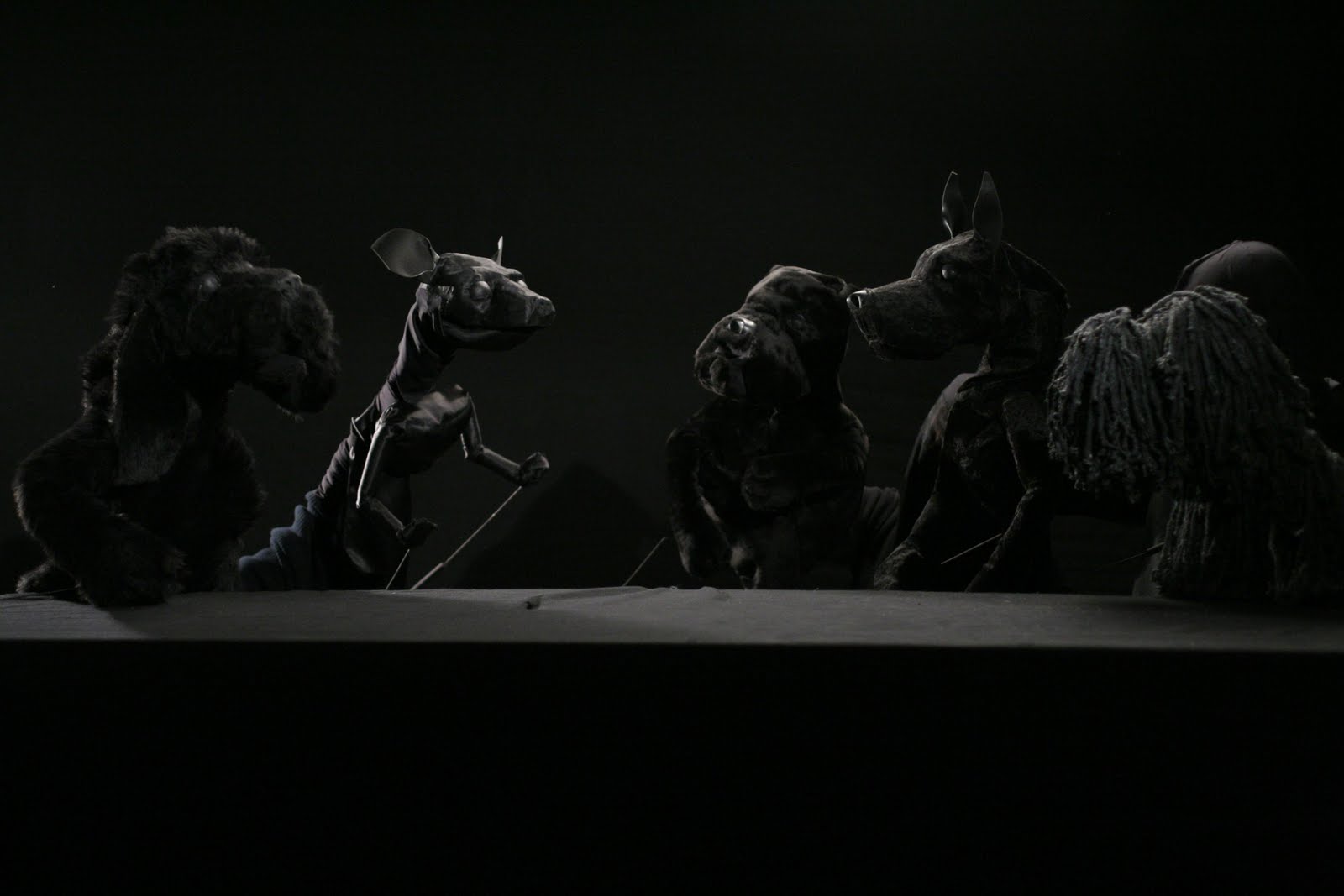
“If we wanna understand the Humans, we gotta see them at their lowest. The Evil—as they call it—that’s what we study today.” This line is the protagonist’s pessimistic view of humanity that opens Ciprian Mureşan’s video Dog Luv, 2009, which premiered at the Romanian Pavilion in the Venice Biennale last year. Based on a script by Saviana Stânescu, Dog Luv was presented at Plan B alongside Untitled (Tom Chamberlain), 2009, a video that teases out the titular English artist’s painting practice. Mureşan’s solo exhibition was the first in the gallery’s new location within an old brush factory—a compound that brings together five galleries and twenty art, design, and performance studios. The artist’s own studio is downstairs, as are those of three other gallery artists; Chamberlain had installed a group of paintings in the artist-run space Laika next door. This cooperative setup has filled an urgent need. Romania still lacks cultural infrastructure; rather than wait for the authorities to act, a core group of artists independently collaborated to take over several floors of the factory. At Plan B, the pairing of Dog Luv, which deals both with the fragile teacher/student relationship and human character more broadly, and Untitled, with the artist working as lone warrior, made perfect sense as a self-critique from within the collective.
Stânescu's dramatic text about humanity’s horrific appetite for torture, interrogation, and execution is played out in Dog Luv by five beautifully hand-crafted puppets of dogs. Maddog, the leader and teacher of the pack, encourages his students to recite the names of various forms of torture practiced throughout history. They do so willingly, rapidly firing off a list that includes stoning, crucifixion, genocide, and water-boarding. He goes on to specify that “the backwards spelling of DOG as GOD is not completely arbitrary.” But it does not take long before his disciples have turned upon him and the play becomes one about the act of torture rather than its theory.
Dog Luv was presented to the left of the space, and to balance its dark intent, Mureşan seems to have looked to the angel on his right shoulder to find Tom Chamberlain. An accomplished painter, Chamberlain works by laying down thousands of repeated, patterned brushstrokes using diluted pigments. The content of each canvas is indefinable and the iridescent surfaces seem evanescent. In production, only the glistening of the wet paint hints at the shapes being formed before each section has time to dry. Mureşan’s video follows the development of one painting and was screened in almost real time over three consecutive days.
The shimmering white of Chamberlain's painting-in-progress on the right thus sat in stark contrast to the dark costumes, backdrop, and content of Dog Luv on the left. In the middle, Skull Study after Holbein, 2009, a pencil drawing of the anamorphic skull Hans Holbein included in The Ambassadors, 1533, may have been Mureşan’s attempt to create a tensile connection between the two videos. The subject’s visual ambiguity is an obvious symbol of mortality, but it also reflects the distortion of Chamberlain’s paintings when viewed in reproduction. The trope somehow bridged the gap between two very different stories of humankind, one of a conspiracy that leads to hatred and violence, the other of the individual who aspires alone.
Setting the Scene/Mark Wallinger

| British artist Mark Wallinger is in Çanakkale for the second time to explore potential sites and participate in meetings with the city mayor and local authorities about his My City public art proposal. As we discuss his ideas for the work, a large cargo ship, the British Curlew, heads north up the strait towards the Marmara Sea. Mark takes a photograph and explains some detail about the curlew's (the bird) distinguishable bill, a knowledge he acquired when he was a young ornithologist many years ago. The name of the boat seems familiar and Mark thinks he saw the same one on his last visit, a repetition that seems more than relevant to our conversation as he later goes on to talk about his ideas for a public artwork in Çanakkale. |
Mark originally considered himself a painter, but during his M.A. and a period of teaching in the art department at Goldsmiths, University of London in the 80s, he was left with a different appetite for his own artistic practice. He goes on to explain that, “as a painter one could happily work within the confines of the form whilst also having the satisfaction of doing a day’s work. To work in a variety of forms requires patience. You have to wait and trust the ideas will come.” His infamous commission Ecce-Homo, a life-size sculpture of Christ that occupied the “Fourth Plinth” in London's Trafalgar Square in 1999, set a new tone for his work, and afterwards he started receiving numerous commissions for public artworks, but while many have been asked of him, not all are realised. One of the projects that did make it to fruition was commissioned by Andrea Schlieker (the curator who also nominated him for the My City project) for the 2008 Folkestone Art Triennial in South England. Mark describes Folk Stones (2008) as “not being a commemorative piece, or about making a grand statement. It was inspired as something more intimate and embedded in the locality of Folkestone.” Folk Stones is a collection of beach pebbles laid out in a massive square, each one individually numbered from 1 all the way up to 19,240 to correspond to the exact number of British soldiers killed on 1 July 1916, the first day of the Battle of the Somme. The work is inspired by the one million soldiers who left from Folkestone Harbour to fight on the battlefields of France and Flanders. Mark describes the numbering as “a significant yet pointless act... a modern-day recalling of the labour of Sisyphus.” Folk Stones is now a permanent public artwork, which clearly engages with the city of Folkestone, and as Mark points out it does so “without being commemorative, or celebratory and without using languages of imperialism.” For him, these aspects are some of the most important when thinking about what a public artwork should be and do today. Iconic sculptures are often based on photographs and hence are forms of commemoration that are merely three-dimensional versions of found images in bronze or stone. Such public artworks simply send the viewer back to the photograph, they are symbols of the past and identifiers of glorious or tragic moments in this history. At this point Mark proposes that, “Perhaps Picasso's painting Guernica was truly the last major public artwork (in terms of art in a new expanded field).” He goes on to say that, “There is nothing for the people in Çanakkale. There is the horse of Troy – a desperate request from Hollywood to insert some kind of touristic reminder, and then there is the text on the hills of Gallipoli that also speaks to the passer by.” In a sense, both the horse and the text act like promotional materials, created only for those who come and go too quickly to absorb the two main historical memories that this city holds – Troy and Gallipoli; on the other hand, there is really no public entity or statement that has been made for those who live here. In contrast, Mark's work in Folkestone was successful in that it did something quite quietly. The emphasis and context directed the local audience's attention to something in the past without stating facts of history. In this story of public art, Mark wants to create for Çanakkale an artwork that is heartfelt, visceral, and that is both a response to how the locality affects him and is also made for the city's people. With these thoughts in mind, Mark recalls that when first invited to the My City project and on being given the site of Çanakkale, he started thinking about the knowledge he already had on the area, the little he knew about Gallipoli, the history of Troy, and the confluence point of the Dardanelles as a place for both trade and conflict throughout the ages. His initial thoughts for Çanakkale became an extension of the work he produced in Folkestone. He says he liked the notion of having thought about a “Western front on the one hand (Folkestone) and that he was now looking at the ramifications of a front at the other end of Europe.” Excited by this prospect, but also nervous of the intensity of the history of Çanakkale, the next concern of his was, “Where does one start when there is so much to address?” While London has been Mark’s main inspiration as it is his base, he has, over the years, worked in a number of divided cities including Lefkosa and Jerusalem. He says that, “Somehow these places feed into all the following work. While a new context can be daunting, by accepting the gifts a place has, new inspirations feed you.” Yet, he also realises that he is recognised for having made several important works that refer to wars and their historical legacy, and that here again, this could be what is expected of him. Although he does not have more than a few experience of Çanakkale, he says, “I feel I have some legitimacy to be working on a public artwork here, given the involvement of Britain in the battle of Gallipoli and the fact that this needs to be a history that is taught more in the UK. What is the meaning of Empire, what could they mobilise?” He also mentions other related references such as English dramatist and poet Christopher Marlowe's unfinished minor epic based on the legend of Hero and Leander, as well as Lord Byron's poetry, and first ever documented swim across the Hellespont from Europe to Asia in 1810. With so many potential inspirations, it was in fact the sea, its persistent use and the people’s connection with the “back-forth motion of the Dardanelles,” that detained Mark for a while. But, he says, “at the same time, the idea of a Camera Obscura or a similar system felt right. He is thus working on a proposal that will create the opportunity for its audience to notice or identify something that makes a spark and at the same time presents a stately and mythological phenomenon that is relentless. Closing the conversation with a reference to Joyce's Ulysses and the mythology of Cyclops, Mark says of the view across the strait, “Here, yesterday suggests tomorrow. Sometimes something momentous takes place, on other days nothing seems to change and the differences are imperceptible. My work will offer a contemplative excuse to keep looking. Sometimes it is nice to simply frame something.” |
Saturday, 20 February 2010
As the land expands
2nd March - 15th April 2010
Al Riwaq Art Space, Bahrain

Can Altay, Fayçal Baghriche, Osman Bozkurt, Shezad Dawood, Mounir Fatmi, Mariam Haji, Basim Magdy, Randa Mirza, Mohamed, Huma Mulji, Rana El Nemr, Fahrettin Örenli, Güclü Öztekin, Mounira Al Solh, Miha Strukelj; with video screenings by artists including Köken Ergun, Ciprian Muresan, Wael Shawky and Erzen Shkololli.
Organised by November Paynter in collaboration with Al Riwaq.
As the land expands is an exhibition that includes art works chosen for their determined urgency and prevalence to the context of Bahrain and the local audience. Taking as a starting point the pool of works in the collection of the ‘Artist Pension Trust, Dubai’, for which Paynter is the Director, over 100 art works that cover a range of media, subject matter and aesthetic tendencies were presented on video and slide to a group of artists and curators during a two day workshop held at Al Riwaq in late 2009. From this presentation a number of art works that seemed the most important to show to a wider audience in Bahrain were selected by the group.
Certain themes and interests dominated the workshop conversation; these included issues of ecology and in particular land reclamation, the speed of urban development in the region and most specifically, in terms of the success and reach of the Al Riwaq gallery, the need to present art works that would provoke a reaction from the local audience. Thus, while the curatorial process was determined by a group decision, and the works presented here do not all relate to any one theme, they do all respond to the location and the current interests of those who participated in the initial selection process.
To make a coherent presentation, a few additional art works have been added to expand on certain themes and ideas, and to also activate the desire to present work in the surrounding neighbourhood of the gallery to include outdoor interventions such as the work Red Zone (a car-cover sewn from kaffiyeh) by Mohamed and a series of open-air video screenings.
Al Riwaq Art Space
P.O. Box 54622
3 Osama Bin Zaid Avenue
Adliya, Bahrain
Telephone: +973 17717441
Fax: +973 17715421
info@alriwaqartspace.com
www.alriwaqartspace.com
Saturday, 6 February 2010
Ciprian Muresan / Yama

For the first time Yama hosts a hand-drawn animation that appears like a sketch on the night sky. A commissioned work by Romanian artist Ciprian Murean Untitled (2010) stems from conversations about his earlier work Pioneers (2008), an installation comprising forty lithographs that depict different children holding bags to their mouths. Many have misread the simple act that appears in each frame and assume that the children are blowing the bags up in order to burst them. Despite their naive appearance, they are in fact shown sniffing glue, a heartbreaking and depressing sight that is all too common in certain inner city areas and one that is particularly familiar to the public of central Istanbul. At the foot of the Marmara Pera and around the zone of Istiklal Caddesi every night young boys can be seen holding a bag of glue to their faces in the same way.
Rather than directly reference this act Muresan instead plays on the misreadings of his previous work and has produced for Yama a more humourous, but still dark, take on the issue. This time, just one child is highlighted and he is seen blowing up a frog that despite its inevitable likelihood of bursting surprises the boy as it explodes into thousands of pieces. A fun gesture turns out to be a cruel or perhaps simply un-controllable act and at the same time the image of the fairytale frog that turns into a prince/princess is thwarted. As we look up at the dark sky Untitled lights up Yama for a few seconds to propose that anyone can make a wish, but in an instant this bubble bursts and the sad reality of disappointment and broken aspirations that afflicts these individuals takes over from the childhood innocence of the frames before.
Commissioned for Yama by November Paynter.
Ciprian Muresan (b. 1977) lives and works in Cluj, Romania. He is an artist and the co-editor of VERSION artist run magazine and from 2005 an editor of IDEA art + society magazine [www.ideamagazine.ro] In 2009 Muresan was one of the representing artists for Romania at the 53rd Venice Biennale; the same year he also participated in among other exhibitions The Generational:Younger Than Jesus at the New Museum, NYC; Communism Never Happened, FEINKOST, Berlin and Incorrigible Believers, David Nolan Gallery, NYC.

Sunday, 15 November 2009
Haris Epaminonda

To the right of the entrance hangs a small, framed book page that depicts a man looking up at a towering termite mound. The unusual scale and perspective of this landscape with figure sets the tone for the formation and play of space experienced in Epaminonda’s “VOL. IV.” The exhibition follows Epaminonda’s solo presentation “VOL. I, II & III,” which took place at the Malmö Konsthall earlier this year, and here the mazelike reorganization of the space contains a series of three-dimensional collages that Epaminonda describes as “sentences. ” While the first is made up of just one found folio—the image of the man and termite mound—subsequent collages mix bought sculptures placed on pedestals with both black-and-white and colorful secondhand bookplates framed and hung or, in the densest composition, stacked against the wall. Her desire to play with traditional museum hierarchies and the usual formats of display is evident in each scene, but also in the way the presentation feels like an illustrated encyclopedia from which different images or shapes are allowed to haunt the memory, the relationships among them left open to interpretation.
What is striking is that the only objects made to measure by Epaminonda are the beautifully crafted pedestals, each one handpainted in a shade of white or eggshell gray, alongside carefully chosen palettes for the numerous frames. This attention to certain details shifts focus onto the pieces whose job it is to support the objects of display, pieces that in this exhibition also take on the more prominent role of masking and hiding selected iconography. A final statement locates the entire exhibition: A delicate wooden sculpture ensquares the gallery’s central column in a tense embrace, framing it as an implied image that ironically can never be captured in publication.
Monday, 2 November 2009


Subscribe to:
Posts (Atom)